protective · from c. 2500 BCE
The Swastika
An auspicious mark used continuously for four and a half thousand years across most of the world, and destroyed as a public sign in the West by twelve years of one European party's use of it.
What the sources claim for it
Well-being and auspicious beginning. In the Indic traditions the mark is placed where something starts — a threshold, a ledger, a ceremony.
History
Where does the Swastika come from?
The figure is a cross with the arms bent at right angles, and it is close to universal. It is stamped on Indus Valley seals by 2500 BCE, painted on Greek pottery as a meander motif, laid in Roman floor mosaics, cut on Anglo-Saxon and Norse metalwork, woven by Navajo and Hopi weavers as the whirling log, and used continuously in Hinduism, Buddhism and Jainism to this day. The Sanskrit name is from svasti, well-being: the mark of what is conducive to good.
Its uses are specific rather than vague. In Hindu practice it is drawn at thresholds, on account books at Diwali, and at the head of documents, and it is associated with Ganesha and with auspicious beginnings. In Buddhism it marks the Buddha's footprints and heart, and in Japan the manji has been the standard map symbol for a temple for over a century. In Jainism its four arms are read as the four states into which a soul may be born. Both rotational directions are in use, and the widespread claim that one direction is benign and the other sinister is a modern tidying-up of a much looser practice.
In Europe and North America it was, until the 1930s, an ordinary good-luck sign with no politics attached. It was a Carlsberg trademark, a Boy Scout merit badge, a Coca-Cola promotional fob, the insignia of the American 45th Infantry Division, and a decorative motif in the tilework of railway stations and libraries.
Afterwards
What did it turn into?
The National Socialist party adopted the Hakenkreuz in 1920, tilted forty-five degrees on a white disc and red ground, and after 1933 attached a state to it. That association has been total in the West ever since: display is a criminal offence in Germany and Austria, and the sign is used by white-nationalist movements worldwide. The consequence falls unevenly. Hindu, Buddhist and Jain communities in the West have spent a century explaining that their swastika is not that one — Japan considered dropping the manji from tourist maps before the 2020 Olympics and kept it after objections — and campaigns to distinguish the two by name have had limited success. This corpus records both: an auspicious mark of four and a half millennia across dozens of unconnected cultures, and a twelve-year European appropriation that has so far outweighed all of it in the places that appropriation reached.
Which texts describe it?
Oldest first, with what each one does with the mark. A mark described in a Bronze Age incantation and a mark first drawn in a seventeenth-century manuscript are different kinds of claim, whatever the shape has in common.
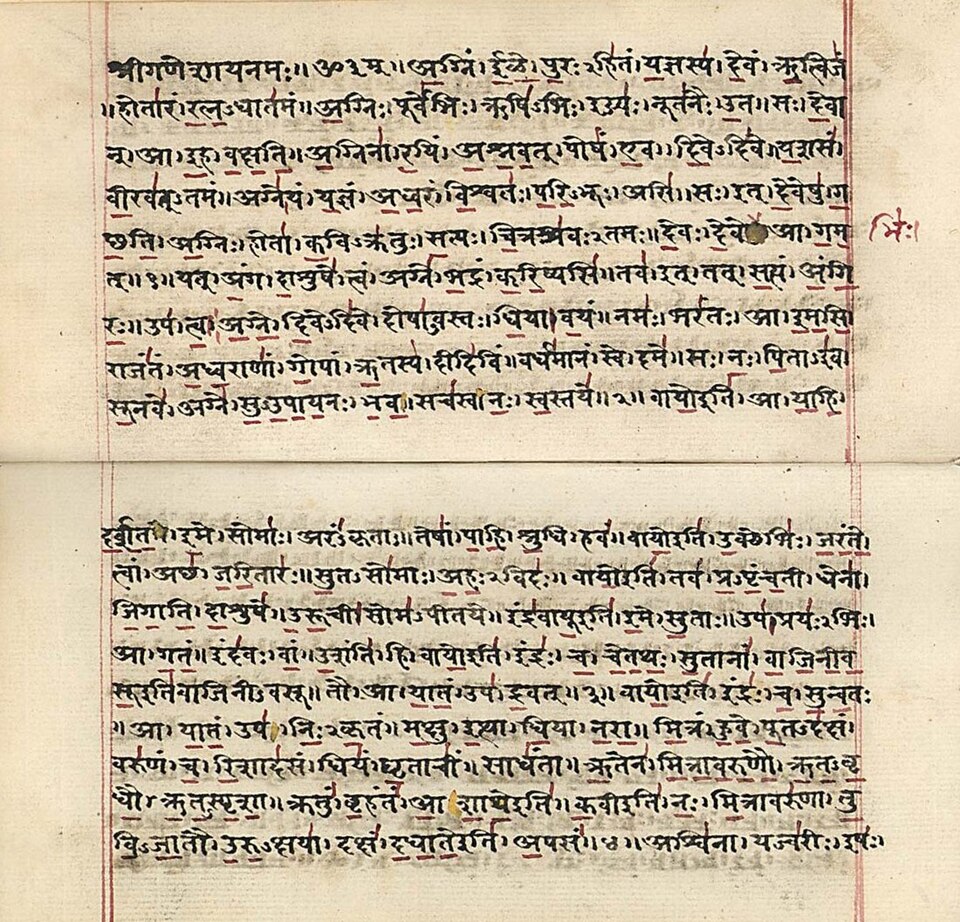
Rigveda
Anonymous; multiple rishi families · c. 1500-1200 BCE · Vedic Sanskrit
The svasti formulas — invocations of well-being — that the name comes from.
Read Rigveda in full ↗Cover: Public domain · Unknown author · Wikimedia file page

The Pali Canon
Anonymous; attributed to the Buddha and his disciples · c. 100 BCE, from oral tradition · Pali
The Buddhist tradition in which the mark denotes the Buddha's footprints and heart.
Read The Pali Canon in full ↗Cover: CC0 · Faredoka · Wikimedia file page
Nearby
Related marks
The Pentagram
A five-pointed star drawn in one unbroken line — an accounting mark, a Pythagorean password, a Christian emblem of the five wounds, and only recently a sign of evil.
The Nazar
Blue glass with a white and black eye at its centre, worn on the theory that a look can be sent back.
Om
A syllable before it was ever a shape — recited at the opening and close of Vedic utterance, and only much later written as the mark everyone recognises.
The Vajra
Indra's thunderbolt, forged from a sage's bones, and later the ritual sceptre of Tibetan Buddhism — a weapon that changed sides.
The Gorgoneion
A severed monster's face on a shield, a roof tile, an oven and a coin — the most-produced apotropaic image of the ancient Mediterranean.
The Ephesia Grammata
Six meaningless Greek words, said to have been written on the statue of Artemis at Ephesus, and spoken or worn as protection for a thousand years.