divine name · from c. 1200 BCE
Om
A syllable before it was ever a shape — recited at the opening and close of Vedic utterance, and only much later written as the mark everyone recognises.
What the sources claim for it
The whole, compressed into one utterance. What is said before anything else is said.
History
Where does Om come from?
Om is a sound. It frames recitation in the Vedic corpus, and the Upanishads treat it at length as the syllable that stands for the whole: its three sounds are analysed as waking, dreaming and deep sleep, with the silence after them as the fourth and highest state.
The written form is a Devanagari ligature and therefore medieval — much younger than the practice, and different in other Indic scripts, which is easy to forget given how fixed the shape looks now. In Hindu, Buddhist, Jain and Sikh use the syllable carries different theological weight, but its position is constant: it goes at the beginning.
Afterwards
What did it turn into?
The most widely recognised Indic symbol worldwide, and the one most often used decoratively with no reference to recitation — a use practising Hindus have objected to when it appears on footwear and swimwear.
Which texts describe it?
Oldest first, with what each one does with the mark. A mark described in a Bronze Age incantation and a mark first drawn in a seventeenth-century manuscript are different kinds of claim, whatever the shape has in common.
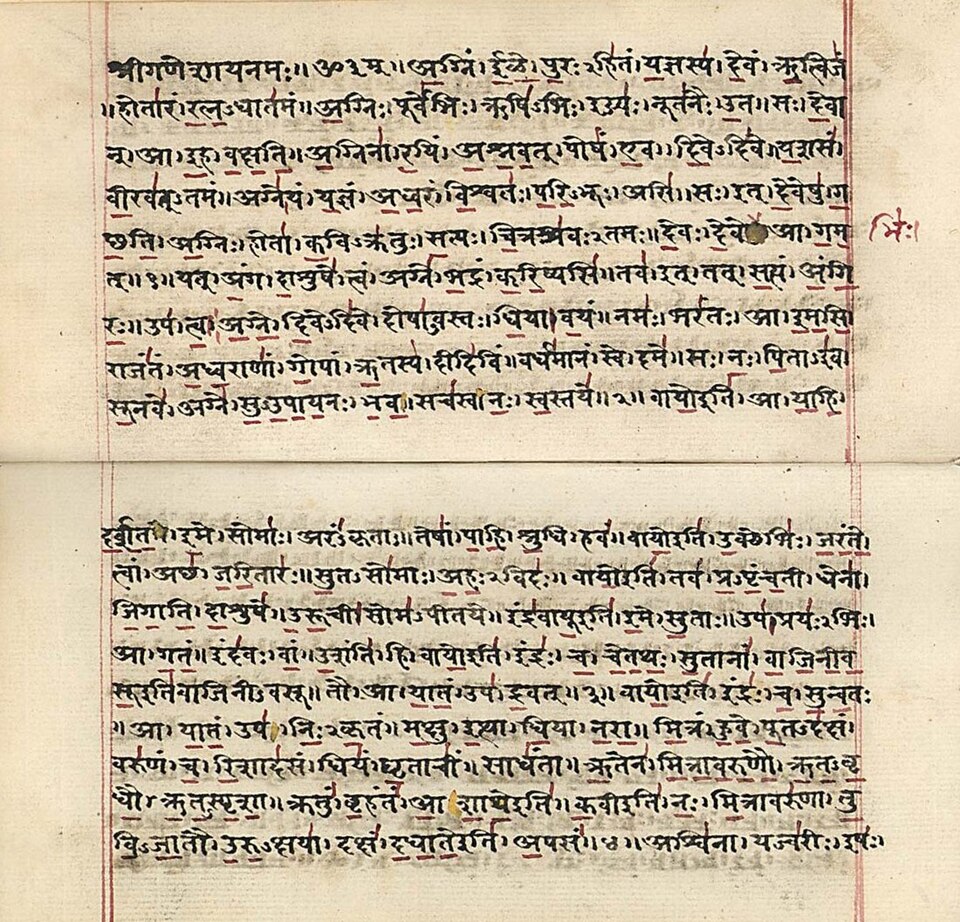
Rigveda
Anonymous; multiple rishi families · c. 1500-1200 BCE · Vedic Sanskrit
The recitational tradition the syllable frames.
Read Rigveda in full ↗Cover: Public domain · Unknown author · Wikimedia file page
Nearby
Related marks
The Swastika
An auspicious mark used continuously for four and a half thousand years across most of the world, and destroyed as a public sign in the West by twelve years of one European party's use of it.
The Vajra
Indra's thunderbolt, forged from a sage's bones, and later the ritual sceptre of Tibetan Buddhism — a weapon that changed sides.
The Dharmachakra
An eight-spoked wheel for an eightfold path — the emblem Buddhism used for its founder for four centuries before it would depict him at all.
The Trishula
A three-pronged spear carried by Shiva and by the goddess in her killing aspect, with the three points read as everything that comes in threes.
The Wheel of Becoming
Six realms in one circle, held in the jaws of the lord of death — a cosmological diagram painted at monastery entrances so that everyone entering has read it.
The Tetragrammaton
Four letters that stopped being pronounced and became, in consequence, the most powerful thing you could write on a piece of equipment.