geometric · from c. 500 CE
The Wheel of Becoming
Six realms in one circle, held in the jaws of the lord of death — a cosmological diagram painted at monastery entrances so that everyone entering has read it.
What the sources claim for it
The whole of conditioned existence, laid out so that the way out of it can be pointed to.
History
Where does the Wheel of Becoming come from?
The bhavachakra is a teaching image with a fixed layout: a hub of three animals for the three poisons, a ring of ascending and descending beings, six segments for the realms of rebirth — gods, demigods, humans, animals, hungry ghosts and hells — and an outer rim of the twelve links of dependent origination. The whole wheel is gripped by Yama, the lord of death.
It is the closest thing in this corpus to a hierarchy diagram drawn by the tradition itself rather than reconstructed by an editor. Where the site's other hierarchies have to be extracted from prose, this one was designed to be read as an image by people who could not read the texts.
3 figures
Who is it attached to?
Figures who carry it
An attribute rather than a signature — held, worn or associated in the texts and the images.
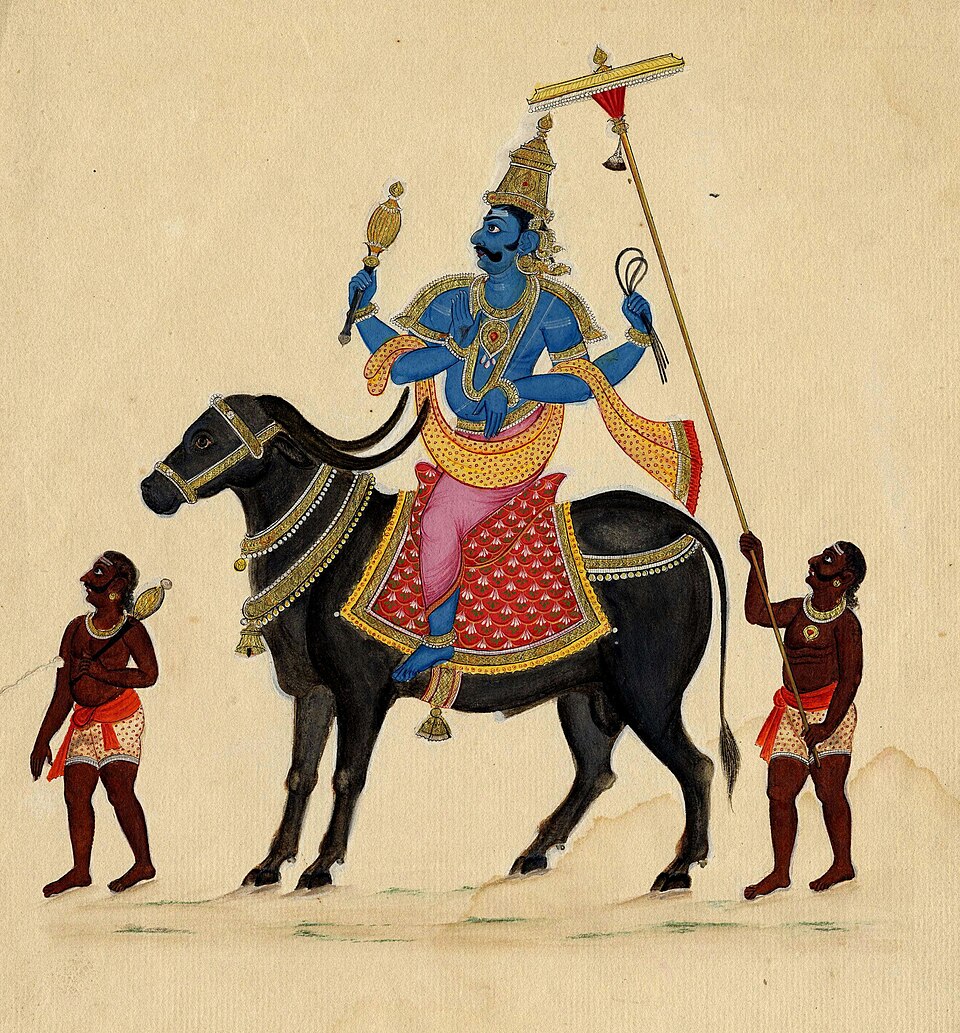
Figures it is used against
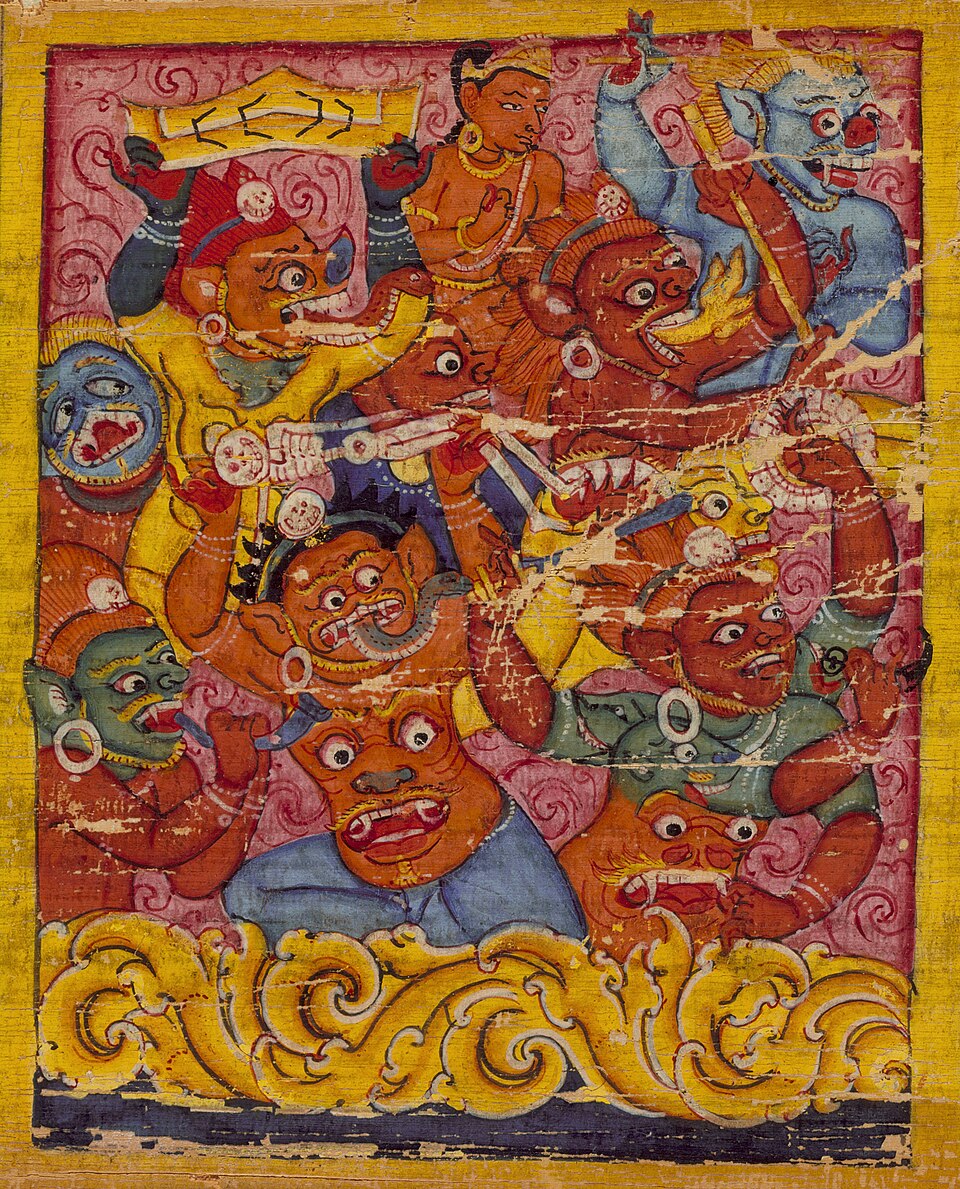
The mark is aimed at them. A ward names its target, which makes these the sharpest attributions on the page.
Afterwards
What did it turn into?
Reproduced constantly in Western books on Buddhism, usually with the twelve-link outer rim unexplained, which removes the argument the diagram is making.
Which texts describe it?
Oldest first, with what each one does with the mark. A mark described in a Bronze Age incantation and a mark first drawn in a seventeenth-century manuscript are different kinds of claim, whatever the shape has in common.
The Pali Canon
Anonymous; attributed to the Buddha and his disciples · c. 100 BCE, from oral tradition · Pali
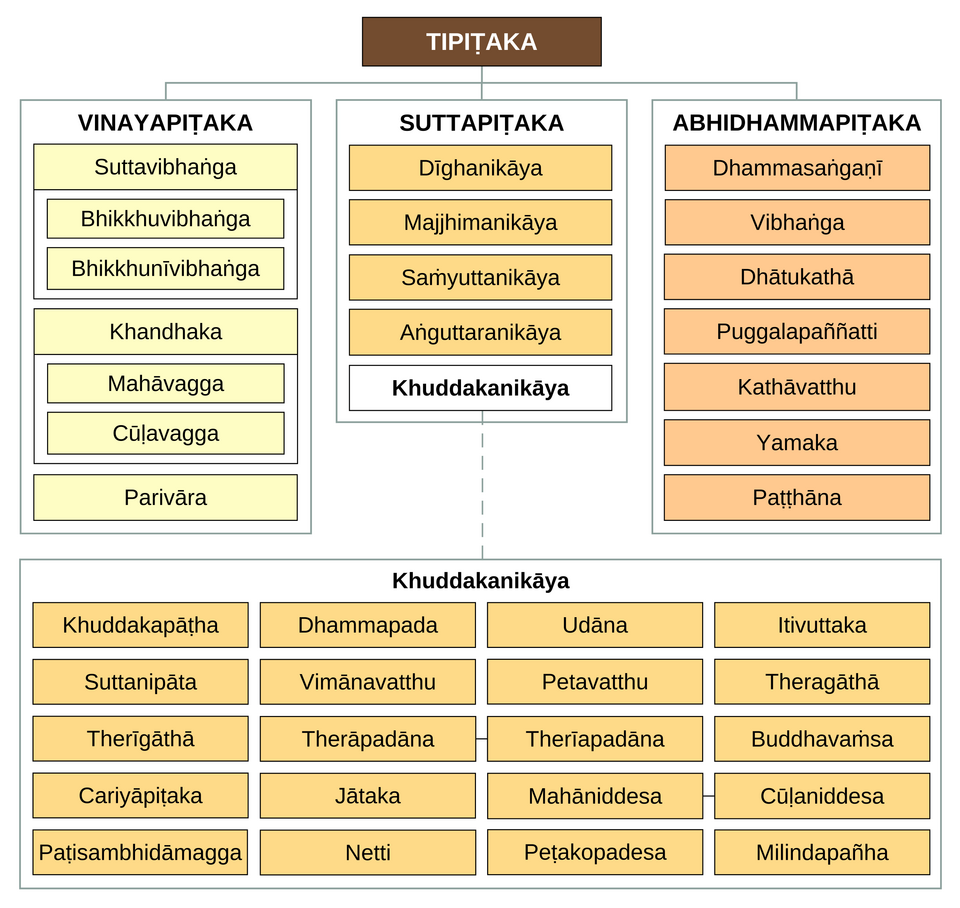
The realms of rebirth and the links of dependent origination the diagram sets out.
Read The Pali Canon in full ↗Cover: CC0 · Faredoka · Wikimedia file page
Nearby
Related marks
The Swastika
An auspicious mark used continuously for four and a half thousand years across most of the world, and destroyed as a public sign in the West by twelve years of one European party's use of it.
Om
A syllable before it was ever a shape — recited at the opening and close of Vedic utterance, and only much later written as the mark everyone recognises.
The Vajra
Indra's thunderbolt, forged from a sage's bones, and later the ritual sceptre of Tibetan Buddhism — a weapon that changed sides.
The Dharmachakra
An eight-spoked wheel for an eightfold path — the emblem Buddhism used for its founder for four centuries before it would depict him at all.
The Triple Spiral
Three joined spirals cut into a kerbstone at Newgrange five thousand years ago — older than the pyramids, and completely unexplained.
The Pentagram
A five-pointed star drawn in one unbroken line — an accounting mark, a Pythagorean password, a Christian emblem of the five wounds, and only recently a sign of evil.