geometric · from c. 3000 BCE
The Pentagram
A five-pointed star drawn in one unbroken line — an accounting mark, a Pythagorean password, a Christian emblem of the five wounds, and only recently a sign of evil.
What the sources claim for it
Wholeness and completion — five parts closing into one unbroken line.
What is it made of?
One continuous line closing on itself in five crossings — drawn without lifting the pen, which is half of what the operative texts claim for it.
The unicursal path
The points
The orientation
Pentagram
- 01
The unicursal path — Five straight strokes, one circuit. An unbroken line is what makes it readable as a sealed boundary.
- 02
The points — Assigned to the four elements plus spirit only in the nineteenth century, by Lévi. No medieval source distributes them that way.
- 03
The orientation — Point up or point down. The inversion carries no infernal meaning before the 1850s, and is standard in medieval Christian use.
History
Where does the Pentagram come from?
The shape is very old and initially very mundane: it appears in Uruk-period Mesopotamian administrative signs. The Pythagoreans made it a token of recognition among members and associated it with health, and the facts that it can be drawn without lifting the pen and contains the golden ratio in its own proportions made it interesting to people who cared about that.
Medieval Christian use is unremarkable and positive: the five wounds of Christ, the five senses, and in Sir Gawain and the Green Knight the endless knot on Gawain's shield, glossed there as a sign of perfect virtue. In the grimoires it is a working figure among many, drawn on pentacles and on floors.
The larger argument
Why is it in a corpus about spirits?
Nothing on the site demonstrates the reception problem more cleanly. The shape is Mesopotamian, then Pythagorean, then a Christian emblem of the five wounds, then Solomonic equipment — and then one nineteenth-century French author attaches a meaning to its inversion that is now the only meaning most readers know. The mark itself did not change.
Afterwards
What did it turn into?
The inversion is modern and datable. Éliphas Lévi in 1855 contrasted the upright star with the reversed one and read the reversed as a goat's head; the Church of Satan adopted that reading in 1966; horror cinema did the rest. Before Lévi, orientation carried no such freight.
Which texts describe it?
Oldest first, with what each one does with the mark. A mark described in a Bronze Age incantation and a mark first drawn in a seventeenth-century manuscript are different kinds of claim, whatever the shape has in common.
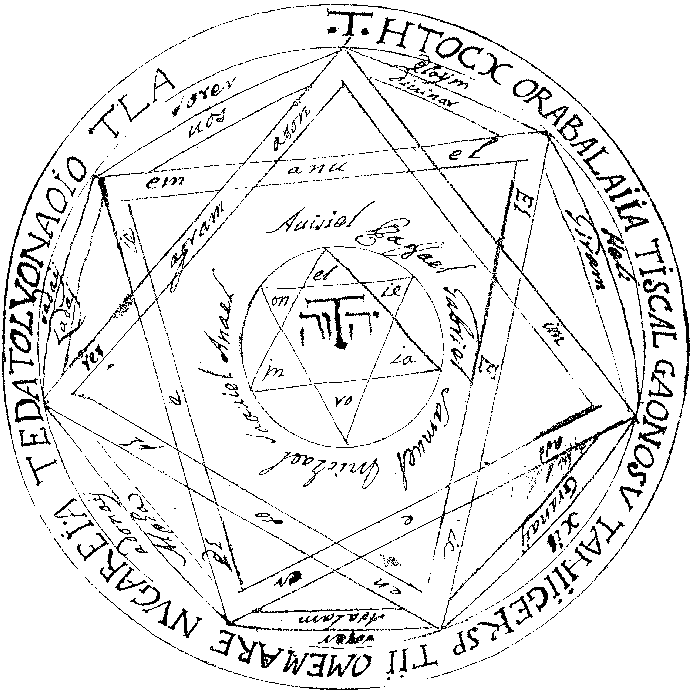
The Key of Solomon (Clavicula Salomonis)
Anonymous; ed. S. L. MacGregor Mathers · 15th-16th c. · Latin and Italian
A working figure on several of the pentacles.
Read The Key of Solomon (Clavicula Salomonis) in full ↗Cover: Public domain · Unknown author · Wikimedia file page
The Magus, or Celestial Intelligencer
Francis Barrett · 1801 · English
Barrett reproduces it among the standard operative figures.
Read The Magus, or Celestial Intelligencer in full ↗Cover: Public domain · Unknown author · Wikimedia file page
Nearby
Related marks
The Circle
A drawn boundary with names written into it — the oldest continuously used device in the Western operative tradition, and the one that defines everything else on the floor.
AGLA
An acronym, not a word: Atah Gibor Le-olam Adonai, 'Thou art mighty forever, Lord', compressed to four letters and written on almost everything.
The Swastika
An auspicious mark used continuously for four and a half thousand years across most of the world, and destroyed as a public sign in the West by twelve years of one European party's use of it.
The Nazar
Blue glass with a white and black eye at its centre, worn on the theory that a look can be sent back.
The Tetragrammaton
Four letters that stopped being pronounced and became, in consequence, the most powerful thing you could write on a piece of equipment.
The Gorgoneion
A severed monster's face on a shield, a roof tile, an oven and a coin — the most-produced apotropaic image of the ancient Mediterranean.