seal · attested from late antiquity
The Circle
A drawn boundary with names written into it — the oldest continuously used device in the Western operative tradition, and the one that defines everything else on the floor.
What the sources claim for it
Standing. The operator occupies a boundary he has no personal power to defend, protected by whose names are written on it.
What is it made of?
Every element of the Solomonic circle is defensive, and each one is a separate claim about who is being protected from what.
The perimeter
The names
The quarters
Lamen and sword
Circle
- 01
The perimeter — Drawn to enclose the operator, not the spirit. The circle is a wall around the people inside it.
- 02
The names — Divine names written around the band, which is what the wall is made of — the barrier is verbal, not geometric.
- 03
The quarters — Four points, with the names and angels of the directions set at them.
- 04
Lamen and sword — The operator's own equipment, carried inside. The circle assumes a person standing in it who is already marked.
History
Where does the Circle come from?
The circle is a jurisdiction. Inside it stand the operator and his assistants; outside it stands everything summoned. The Key of Solomon devotes a chapter to laying it out — ground prepared, circle traced with a consecrated knife, divine names inscribed between concentric rings, censers at the quarters — and the Ars Goetia inherits the arrangement almost unaltered.
What makes the circle legally interesting rather than merely defensive is that the names written on it are not the operator's. They are divine and angelic names, and their presence is what the spirit is asked to respect. A circle without them is a chalk ring; a circle with them is a claim of protected standing, which is why the texts spend more words on the inscriptions than on the geometry.
The larger argument
Why is it in a corpus about spirits?
The circle is the clearest evidence that the grimoire tradition took its own spirits seriously. Nobody builds a wall of names around themselves for a procedure they believe is symbolic. Read next to the triangle — a second enclosure, for the spirit — it shows a system designed around a real fear of what answers.
Afterwards
What did it turn into?
The one grimoire device that stage magic, illustration and film kept when they dropped the rest — usually drawn empty, which removes the only part the sources say does the work.
Which texts describe it?
Oldest first, with what each one does with the mark. A mark described in a Bronze Age incantation and a mark first drawn in a seventeenth-century manuscript are different kinds of claim, whatever the shape has in common.
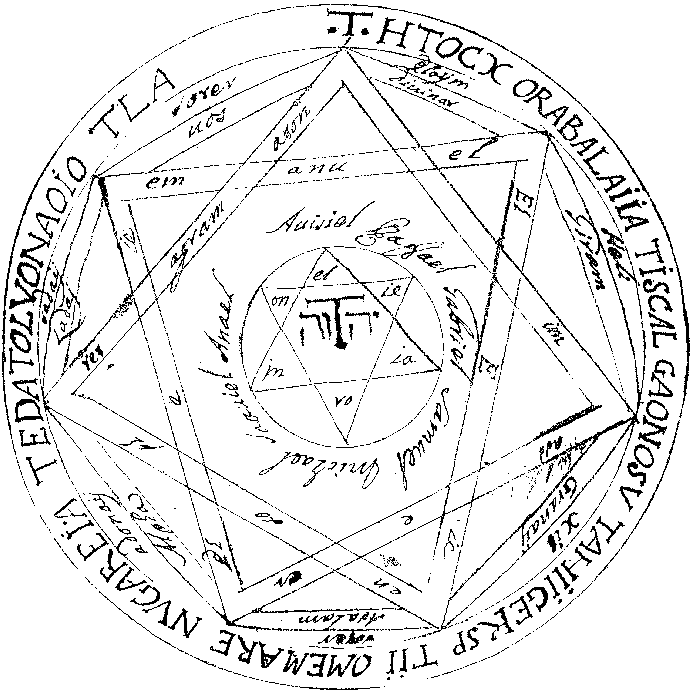
The Key of Solomon (Clavicula Salomonis)
Anonymous; ed. S. L. MacGregor Mathers · 15th-16th c. · Latin and Italian
A full chapter on construction, inscription and consecration.
Read The Key of Solomon (Clavicula Salomonis) in full ↗Cover: Public domain · Unknown author · Wikimedia file page
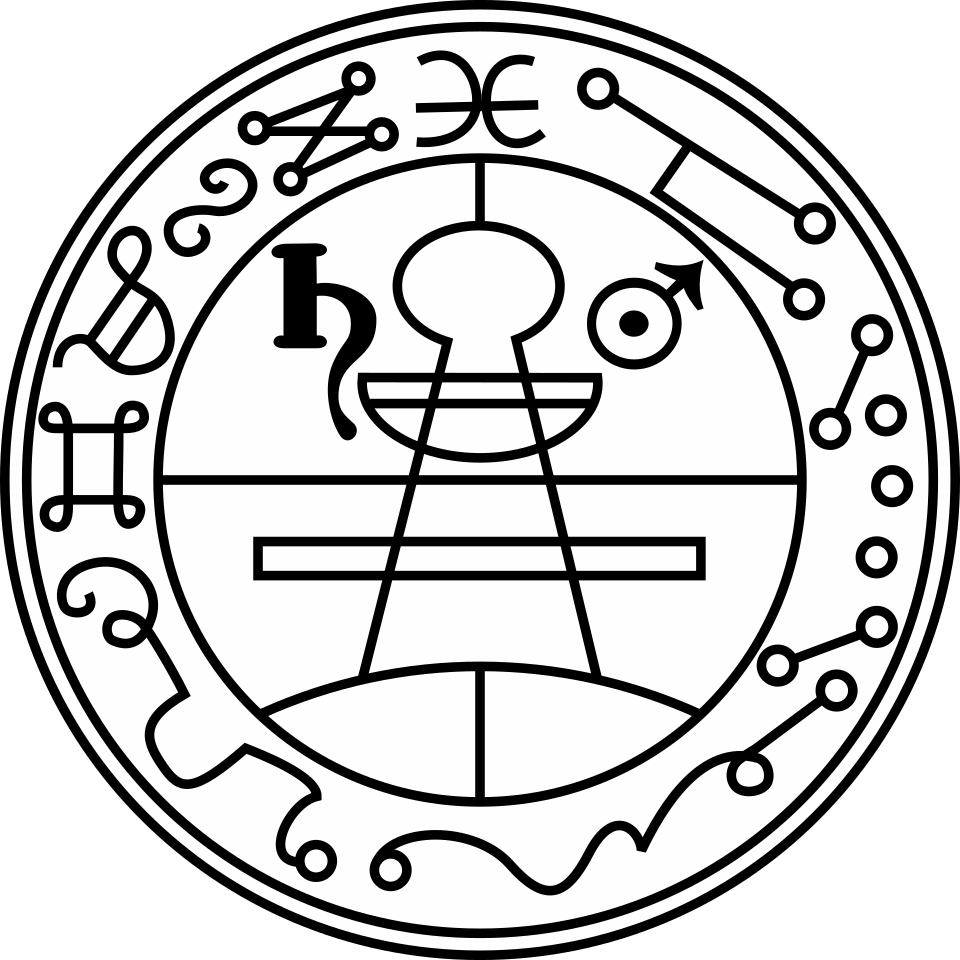
The Lesser Key of Solomon, Book I: Ars Goetia
Anonymous; ed. S. L. MacGregor Mathers & A. E. Waite · 17th c.; ed. 1904 · English (from Latin)
Inherits the arrangement, paired with the triangle set outside it.
Read The Lesser Key of Solomon, Book I: Ars Goetia in full ↗Cover: Public domain · anonymous design, redrawn by User:Fuzzypeg · Wikimedia file page
Nearby
Related marks
The Pentagram
A five-pointed star drawn in one unbroken line — an accounting mark, a Pythagorean password, a Christian emblem of the five wounds, and only recently a sign of evil.
AGLA
An acronym, not a word: Atah Gibor Le-olam Adonai, 'Thou art mighty forever, Lord', compressed to four letters and written on almost everything.
The Tetragrammaton
Four letters that stopped being pronounced and became, in consequence, the most powerful thing you could write on a piece of equipment.
The Sator Square
Five Latin words in a grid that reads the same in four directions, scratched on a wall at Pompeii and still being cut into churches a thousand years later.
Abracadabra
A word written as a shrinking triangle, one letter dropped per line, so that the fever it is written against diminishes with it.
The Brass Vessel
The container the legend says Solomon sealed the spirits into, thrown into a lake and opened by Babylonians who expected treasure. It is where the Ars Goetia says its seventy-two came from.