divine name · before 79 CE
The Sator Square
Five Latin words in a grid that reads the same in four directions, scratched on a wall at Pompeii and still being cut into churches a thousand years later.
What the sources claim for it
Disputed. The demonstrable property is the symmetry, and the documented use is protective.
What is it made of?
Five five-letter Latin words arranged so the grid reads the same across, down, backwards and upwards — and which can be rearranged into a cross of PATERNOSTER sharing one N, leaving two As and two Os over.
Sator
Arepo
Tenet
Opera
Rotas
Sator Square
- 01
Sator — 'Sower', or a farmer — the nominative subject, if the square is a sentence at all.
- 02
Arepo — Attested nowhere else in Latin. Most likely a name invented to make the square close.
- 03
Tenet — 'Holds'. The palindrome at the centre, and the axis the whole square turns on.
- 04
Opera — 'Works', or 'with effort'.
- 05
Rotas — 'Wheels' — SATOR backwards, which is what makes the grid symmetrical in all four directions.
History
Where does the Sator Square come from?
SATOR AREPO TENET OPERA ROTAS forms a five-by-five palindromic square: identical read left to right, right to left, top to bottom and bottom to top. Two examples survive at Pompeii, which fixes it before the eruption of 79 CE, and it then appears across Europe for well over a millennium — in manuscripts, on church walls, on amulets, and in folk practice against fire, madness and sickness in cattle.
Its meaning is unresolved and probably was from the start. AREPO is not a Latin word attested anywhere else, the letters can be rearranged into a double PATERNOSTER with A and O left over, and readings as Christian, Jewish, Mithraic and simply ludic have all been argued. The corpus can date it precisely and cannot explain it at all, which is a combination worth showing.
The larger argument
Why is it in a corpus about spirits?
The square is on walls at Pompeii, so it is in use before 79 CE, which puts the PATERNOSTER reading under real strain as an origin story even though the letters do rearrange. It belongs here as a warning about the whole symbol side: a mark can be genuinely old, genuinely apotropaic, and still have its most satisfying explanation attached long after the fact.
Afterwards
What did it turn into?
One of the longest continuous uses of any written charm in Europe; still occasionally reported in twentieth-century folk practice, and a favourite of puzzle and cipher literature.
Which texts describe it?
Oldest first, with what each one does with the mark. A mark described in a Bronze Age incantation and a mark first drawn in a seventeenth-century manuscript are different kinds of claim, whatever the shape has in common.
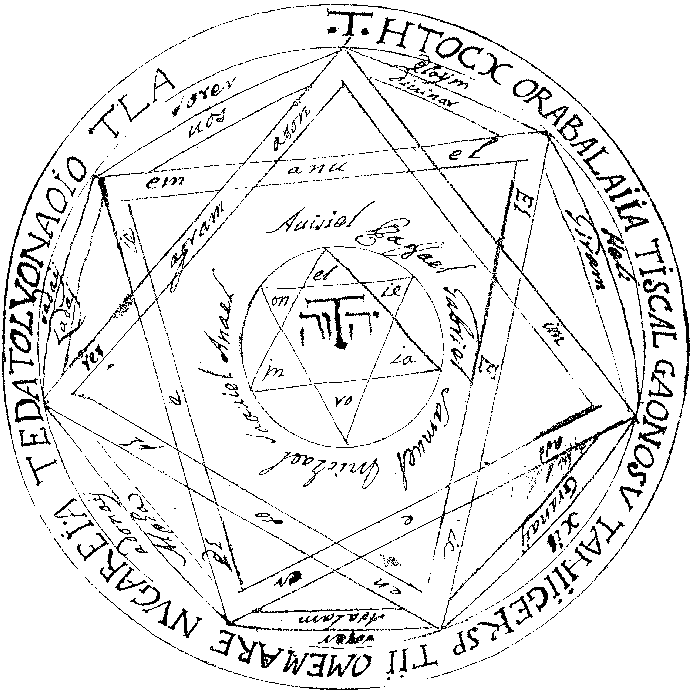
The Key of Solomon (Clavicula Salomonis)
Anonymous; ed. S. L. MacGregor Mathers · 15th-16th c. · Latin and Italian
Belongs to the same stock of written charms the grimoire tradition draws on.
Read The Key of Solomon (Clavicula Salomonis) in full ↗Cover: Public domain · Unknown author · Wikimedia file page
Nearby
Related marks
The Pentagram
A five-pointed star drawn in one unbroken line — an accounting mark, a Pythagorean password, a Christian emblem of the five wounds, and only recently a sign of evil.
Abracadabra
A word written as a shrinking triangle, one letter dropped per line, so that the fever it is written against diminishes with it.
The Circle
A drawn boundary with names written into it — the oldest continuously used device in the Western operative tradition, and the one that defines everything else on the floor.
AGLA
An acronym, not a word: Atah Gibor Le-olam Adonai, 'Thou art mighty forever, Lord', compressed to four letters and written on almost everything.
Witch Marks
Compass-drawn flowers, interlocking Vs and burn marks scratched into beams beside doors, windows and hearths in ordinary English buildings — protection with no text and no clergy attached.
The Sigil of Baphomet
An inverted pentagram, a goat's head fitted inside it, and the Hebrew letters of Leviathan around the rim — three separate nineteenth- and twentieth-century additions, presented as one ancient mark.