protective · c. 1500–1750
Witch Marks
Compass-drawn flowers, interlocking Vs and burn marks scratched into beams beside doors, windows and hearths in ordinary English buildings — protection with no text and no clergy attached.
What the sources claim for it
A hazard at the opening is met at the opening. The unbroken line of the hexafoil is generally read as a trap or a snare for whatever tries to enter.
History
Where does Witch Marks come from?
The commonest is the hexafoil, a six-petalled flower drawn with a compass inside a circle, cut into a lintel or a joist. Others are interlocking Vs, read as VV for Virgo Virginum, Mary; tangled mesh patterns understood as snares; and deliberate scorch marks made with a taper. They cluster with complete consistency at openings — doorways, window frames, chimney breasts, the entrance to a cellar — which is what identifies them as protective rather than decorative.
They are ordinary rather than learned. Nobody wrote a manual, no text prescribes them, and they occur in houses, barns and churches alike across the period when England is also running witch trials. The evidence is entirely archaeological, which puts them in the same category as the incantation bowls: what people actually did, as distinct from what the books of the period say they should have done.
Afterwards
What did it turn into?
Systematically recorded only in the last two decades, and consistently misdated by owners who assume the marks are carpenter's setting-out lines — some are, which is exactly why they took so long to be recognised.
Which texts describe it?
Oldest first, with what each one does with the mark. A mark described in a Bronze Age incantation and a mark first drawn in a seventeenth-century manuscript are different kinds of claim, whatever the shape has in common.
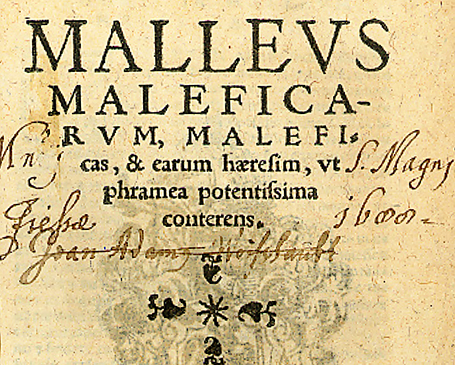
Malleus Maleficarum
Heinrich Kramer and Jacob Sprenger · 1487 · Latin
The learned demonology running in the same centuries, which prescribes nothing of the kind.
Read Malleus Maleficarum in full ↗Cover: Public domain · Unknown author · Wikimedia file page
Nearby
Related marks
The Pentagram
A five-pointed star drawn in one unbroken line — an accounting mark, a Pythagorean password, a Christian emblem of the five wounds, and only recently a sign of evil.
The Sator Square
Five Latin words in a grid that reads the same in four directions, scratched on a wall at Pompeii and still being cut into churches a thousand years later.
Abracadabra
A word written as a shrinking triangle, one letter dropped per line, so that the fever it is written against diminishes with it.
The Circle
A drawn boundary with names written into it — the oldest continuously used device in the Western operative tradition, and the one that defines everything else on the floor.
AGLA
An acronym, not a word: Atah Gibor Le-olam Adonai, 'Thou art mighty forever, Lord', compressed to four letters and written on almost everything.
The Sigil of Baphomet
An inverted pentagram, a goat's head fitted inside it, and the Hebrew letters of Leviathan around the rim — three separate nineteenth- and twentieth-century additions, presented as one ancient mark.