seal · assembled 1897–1969
The Sigil of Baphomet
An inverted pentagram, a goat's head fitted inside it, and the Hebrew letters of Leviathan around the rim — three separate nineteenth- and twentieth-century additions, presented as one ancient mark.
What the sources claim for it
A deliberate inversion — the point-down star, the beast in place of the man — designed as an opposition to Christian symbolism rather than as a survival of anything older.
What is it made of?
Three separate additions, each of them datable, presented afterwards as one ancient mark.
The inversion
The goat
The letters
The cover
Sigil of Baphomet
- 01
The inversion — Eliphas Lévi gives the point-down pentagram its infernal reading. Before him the orientation carries no such meaning.
- 02
The goat — Stanislas de Guaita prints a goat's head fitted to the inverted star — the specific image everything later copies.
- 03
The letters — Leviathan in Hebrew, one letter to each point, read counter-clockwise from the bottom. Later again.
- 04
The cover — Adopted by the Church of Satan in 1966 and printed on the Satanic Bible in 1969, which is how it reaches everybody else.
History
Where does the Sigil of Baphomet come from?
It can be dated component by component. Eliphas Lévi gives the inverted pentagram its infernal reading in the 1850s and draws his Baphomet figure — neither of which had that meaning before him. Stanislas de Guaita prints a goat's head fitted to an inverted pentagram in 1897. The five Hebrew letters of Leviathan, set one to each point and read counter-clockwise from the bottom, are added later, and the whole is adopted by Anton LaVey's Church of Satan in 1966 and printed on the cover of the Satanic Bible in 1969.
No part of this is medieval, and the name attached to it belongs to a different argument entirely: Baphomet appears in the Templar trial records of 1307 as a confession extracted under torture, with no image and no description that any of these elements come from.
1 figure
Who is it attached to?
Figures who carry it
An attribute rather than a signature — held, worn or associated in the texts and the images.
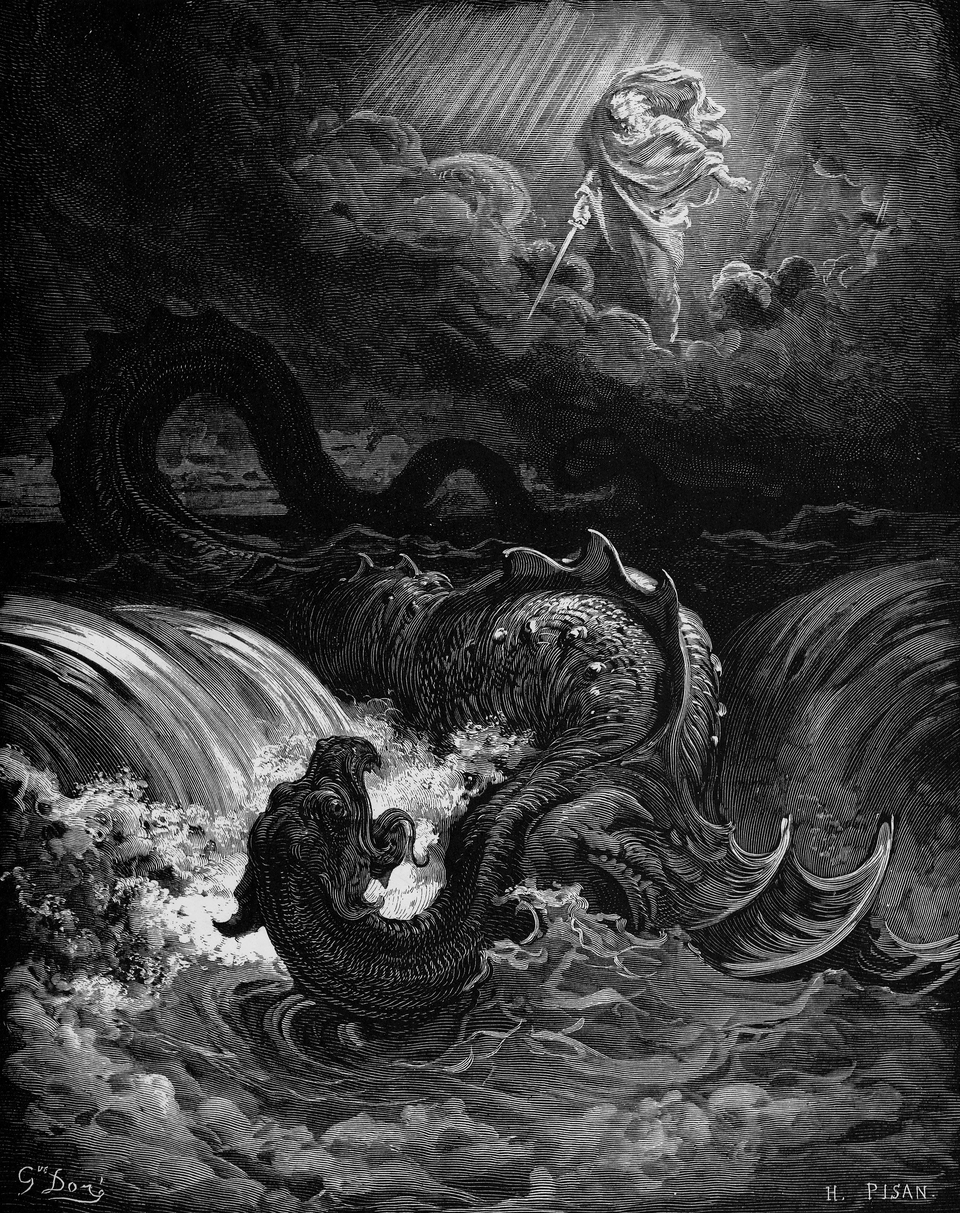
The larger argument
Why is it in a corpus about spirits?
The most instructive object on the site, because every step of its assembly is documented and none of the steps is old. The name attached to it comes from confessions extracted under torture in 1307 which describe no image at all. If a reader takes one method away from this section, it should be the habit of asking a mark for its earliest dated appearance rather than for its tradition.
Afterwards
What did it turn into?
Consistently presented, by supporters and opponents alike, as an ancient sign of devil worship. It is the most instructive object on the site precisely because every step of its assembly is documented and none of the steps is old.
Which texts describe it?
Oldest first, with what each one does with the mark. A mark described in a Bronze Age incantation and a mark first drawn in a seventeenth-century manuscript are different kinds of claim, whatever the shape has in common.
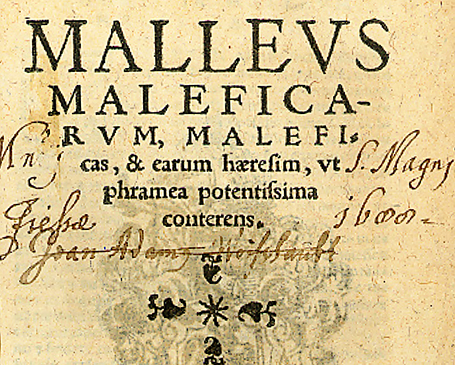
Malleus Maleficarum
Heinrich Kramer and Jacob Sprenger · 1487 · Latin
The earlier witch-trial material later assumed to lie behind the image, which describes nothing like it.
Read Malleus Maleficarum in full ↗Cover: Public domain · Unknown author · Wikimedia file page
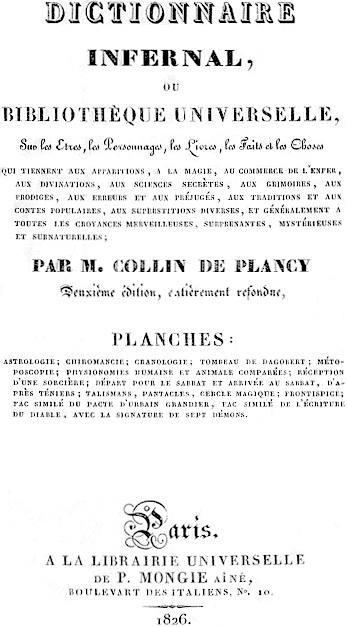
Dictionnaire Infernal
Jacques Collin de Plancy · 1818; illustrated ed. 1863 · French
The nineteenth-century French demonology this iconography grows directly out of.
Read Dictionnaire Infernal in full ↗Cover: Public domain · Collin de Plancy · Wikimedia file page
Nearby
Related marks
The Pentagram
A five-pointed star drawn in one unbroken line — an accounting mark, a Pythagorean password, a Christian emblem of the five wounds, and only recently a sign of evil.
The Sator Square
Five Latin words in a grid that reads the same in four directions, scratched on a wall at Pompeii and still being cut into churches a thousand years later.
Abracadabra
A word written as a shrinking triangle, one letter dropped per line, so that the fever it is written against diminishes with it.
The Circle
A drawn boundary with names written into it — the oldest continuously used device in the Western operative tradition, and the one that defines everything else on the floor.
AGLA
An acronym, not a word: Atah Gibor Le-olam Adonai, 'Thou art mighty forever, Lord', compressed to four letters and written on almost everything.
Witch Marks
Compass-drawn flowers, interlocking Vs and burn marks scratched into beams beside doors, windows and hearths in ordinary English buildings — protection with no text and no clergy attached.