divine name · from c. 1200
AGLA
An acronym, not a word: Atah Gibor Le-olam Adonai, 'Thou art mighty forever, Lord', compressed to four letters and written on almost everything.
What the sources claim for it
A compressed declaration of divine power, used as a name of God.
What is it made of?
A notariqon: one letter taken from each word of a Hebrew sentence, Atah Gibor Le-olam Adonai, and read afterwards as though it were a name in its own right.
Aleph
Atah
Gimel
Gibor
Lamed
Le-olam
Aleph
Adonai
AGLA
- 01
Aleph · Atah — 'Thou art'.
- 02
Gimel · Gibor — 'mighty'.
- 03
Lamed · Le-olam — 'forever'.
- 04
Aleph · Adonai — 'Lord' — itself already a substitute, the word said aloud in place of the Tetragrammaton.
History
Where does AGLA come from?
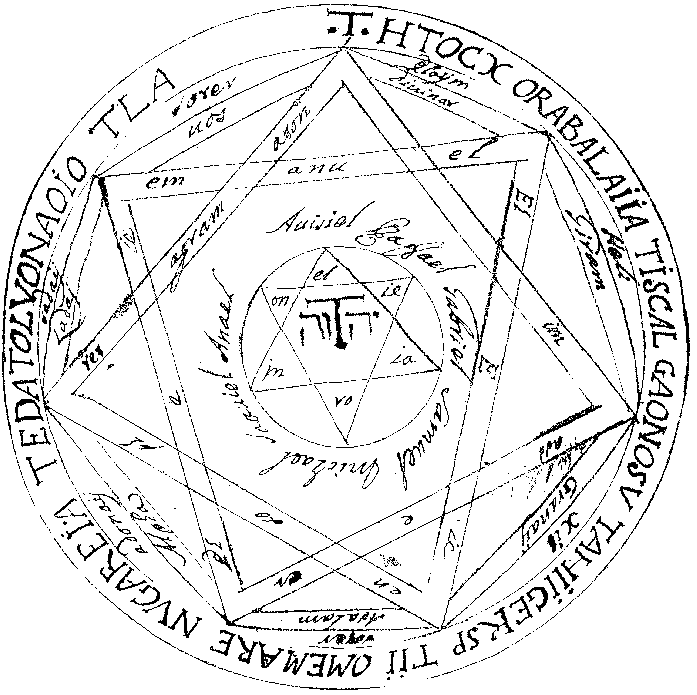
AGLA is a notariqon, a name built from the initial letters of a phrase, and the phrase is a line of Jewish liturgy. Once compressed it circulates as a name in its own right through Latin magical manuscripts, on amulets, on rings, on church bells, and on the quarters of the Solomonic circle.
It shows how the operative tradition treats language. A sentence in Hebrew liturgy becomes a four-letter token; the token is copied by scribes who cannot expand it; and by the early modern period AGLA is listed alongside genuine divine names as though it were one — which, within that tradition, it now effectively is.
The larger argument
Why is it in a corpus about spirits?
AGLA is what transmission looks like when it works and nobody notices. A line of Jewish liturgy is compressed to four letters, the four letters are copied by Latin scribes who cannot expand them, and within a few centuries AGLA is written on circles and church bells beside genuine divine names as if it were one. The same process, run on spirit names rather than divine ones, is how a Canaanite title ends up as a demon in a seventeenth-century list.
Afterwards
What did it turn into?
Survives on medieval bells and rings across Europe, and in every printed grimoire that copies the Solomonic circle.
Which texts describe it?
Oldest first, with what each one does with the mark. A mark described in a Bronze Age incantation and a mark first drawn in a seventeenth-century manuscript are different kinds of claim, whatever the shape has in common.
The Key of Solomon (Clavicula Salomonis)
Anonymous; ed. S. L. MacGregor Mathers · 15th-16th c. · Latin and Italian
Written at the quarters of the circle among the other names.
Read The Key of Solomon (Clavicula Salomonis) in full ↗Cover: Public domain · Unknown author · Wikimedia file page
The Magus, or Celestial Intelligencer
Francis Barrett · 1801 · English
Listed with the divine names in Barrett's tables.
Read The Magus, or Celestial Intelligencer in full ↗Cover: Public domain · Unknown author · Wikimedia file page
Nearby
Related marks
The Pentagram
A five-pointed star drawn in one unbroken line — an accounting mark, a Pythagorean password, a Christian emblem of the five wounds, and only recently a sign of evil.
The Tetragrammaton
Four letters that stopped being pronounced and became, in consequence, the most powerful thing you could write on a piece of equipment.
The Circle
A drawn boundary with names written into it — the oldest continuously used device in the Western operative tradition, and the one that defines everything else on the floor.
The Brass Vessel
The container the legend says Solomon sealed the spirits into, thrown into a lake and opened by Babylonians who expected treasure. It is where the Ars Goetia says its seventy-two came from.
The Hexagram
Two interlocked triangles that were ornament almost everywhere before they were a Jewish emblem anywhere — and a spirit-binding seal in between.
The Lamen
The one piece of Solomonic equipment worn rather than drawn: a disc at the breast carrying the divine names, and the operator's own credential rather than the spirit's.