geometric · protective use from c. 1200 CE
The Hexagram
Two interlocked triangles that were ornament almost everywhere before they were a Jewish emblem anywhere — and a spirit-binding seal in between.
What the sources claim for it
In the magical texts, containment: a closed figure a spirit cannot cross. In communal use, identity — a meaning it acquired without any doctrinal statement.
What is it made of?
Two equilateral triangles, each meaningless alone, overlaid so that neither is subordinate to the other.
Point up
Point down
Interlaced
Hexagram
- 01
Point up — In alchemical notation, fire. In the elemental reading later attached to the figure, the ascending principle.
- 02
Point down — Water. The descending principle, and the half that makes the figure a statement about a pair rather than a shape.
- 03
Interlaced — Six points and a hexagon at the centre. Late antique ornament, medieval binding-seal, national flag by 1948 — with nothing in the geometry recording the change.
History
Where does the Hexagram come from?
As a decorative figure the hexagram is nearly universal and carries no consistent meaning: Roman mosaics, Byzantine and Islamic ornament, medieval churches. Its specifically magical use develops in medieval Jewish and Islamic practice, where it is the seal that binds spirits, frequently under the name of Solomon rather than David.
The communal identification comes much later. Prague's Jewish community uses it as a flag device in the fourteenth century; it becomes a general Jewish emblem across Europe in the nineteenth, largely by analogy with the cross's role for Christianity; it is imposed as a badge under Nazi rule; and it goes onto the flag of Israel in 1948. Almost none of that history is legible in the shape itself.
The larger argument
Why is it in a corpus about spirits?
The hexagram is the site's standing example of why marks are harder to trace than names. A name moving between traditions leaves a paper trail of translation and transliteration. This shape moved from ornament to seal to sovereign emblem and left nothing behind at all, which is why every entry here separates what a text claims for a mark from what the mark later became.
Afterwards
What did it turn into?
The only symbol in this corpus whose modern meaning is primarily national, and one where the older binding use is now largely invisible to the people who see it every day.
Which texts describe it?
Oldest first, with what each one does with the mark. A mark described in a Bronze Age incantation and a mark first drawn in a seventeenth-century manuscript are different kinds of claim, whatever the shape has in common.
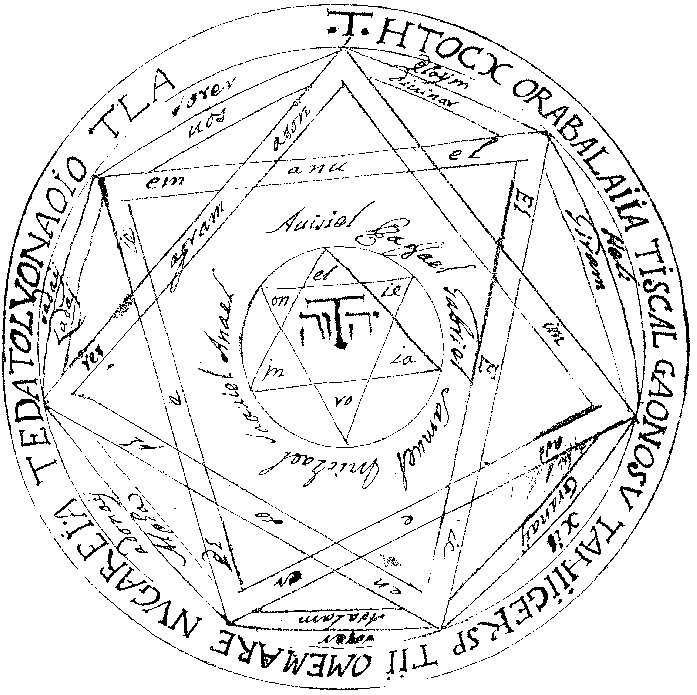
The Key of Solomon (Clavicula Salomonis)
Anonymous; ed. S. L. MacGregor Mathers · 15th-16th c. · Latin and Italian
Used among the pentacle figures as a containing form.
Read The Key of Solomon (Clavicula Salomonis) in full ↗Cover: Public domain · Unknown author · Wikimedia file page
Etz Chaim & Lurianic Kabbalah
Isaac Luria, recorded by Chaim Vital · 16th c. · Hebrew
Circulates in the amulet practice attached to the Safed school.
Read Etz Chaim & Lurianic Kabbalah in full ↗Cover: CC BY-SA 3.0 · Louski1 · Wikimedia file page
Nearby
Related marks
The Seal of Solomon
A signet ring, not a shape. The Testament of Solomon makes it the instrument by which every demon in the book is compelled to give its name.
The Brass Vessel
The container the legend says Solomon sealed the spirits into, thrown into a lake and opened by Babylonians who expected treasure. It is where the Ars Goetia says its seventy-two came from.
The Hamsa
An open hand against the evil eye, claimed in nearly identical form by Jewish, Muslim and Christian communities across the same geography.
AGLA
An acronym, not a word: Atah Gibor Le-olam Adonai, 'Thou art mighty forever, Lord', compressed to four letters and written on almost everything.
The Pentagram
A five-pointed star drawn in one unbroken line — an accounting mark, a Pythagorean password, a Christian emblem of the five wounds, and only recently a sign of evil.
The Standing Stone
An upright unworked stone marking a place where something happened — the oldest kind of monument, and one the Bible both erects and forbids.