What the sources claim for it
Standing, worn where it can be seen. The lamen answers the question a summoned spirit is imagined to ask first — by what authority, and who is asking.
What is it made of?
Two claims on one disc, which is what makes the lamen different from every other instrument in the set.
The disc
The divine names
The spirit's seal
The cord
Lamen
- 01
The disc — Silver, parchment or virgin wax, made under the planetary hour the manuscript specifies.
- 02
The divine names — The operator's warrant, in the same letters that appear on the circle and the pentacles.
- 03
The spirit's seal — The Ars Goetia sets the seal of the spirit being called on the same face — the address, beside the authority.
- 04
The cord — Hung at the breast, where the spirit is meant to see it. This is the only instrument that has to be legible from outside.
History
Where does the Lamen come from?
Where the circle protects the ground and the triangle constrains the spirit, the lamen goes on the person. It is a disc or plate — silver, parchment or virgin wax depending on the manuscript — hung at the breast on a cord or a chain, inscribed with divine names and, in the Ars Goetia, with the seal of the spirit being called.
That double use is the interesting part. The same object carries the authority the operator is claiming and the identity of the thing he is calling, which means it functions as both a badge of office and an address. The Ars Goetia is explicit that the lamen must be worn during the conjuration and shown to the spirit; the Key of Solomon treats it as one of a set of consecrated instruments to be made under the right planetary hour, and the medieval Latin tradition behind both takes it from ecclesiastical vestment as much as from anything magical.
The larger argument
Why is it in a corpus about spirits?
The lamen is the corpus's compulsion claim reduced to one wearable object: this is who I am, this is who you are, and here is the authority under which I am asking. Modern reproductions keep the seal and drop the names, which is the same edit reception performs everywhere on this site — the equipment survives and the argument it was making does not.
Afterwards
What did it turn into?
Reproduced constantly in modern occult practice, usually as a printed disc of a single Goetic seal with the divine names dropped. The half that carried the operator's warrant is the half that fell away.
Which texts describe it?
Oldest first, with what each one does with the mark. A mark described in a Bronze Age incantation and a mark first drawn in a seventeenth-century manuscript are different kinds of claim, whatever the shape has in common.
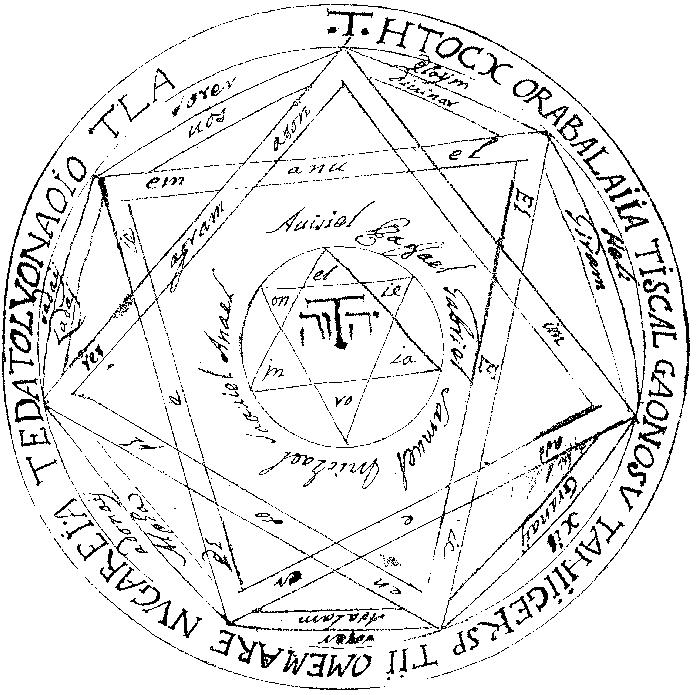
The Key of Solomon (Clavicula Salomonis)
Anonymous; ed. S. L. MacGregor Mathers · 15th-16th c. · Latin and Italian
Made and consecrated with the other instruments, under a specified hour.
Read The Key of Solomon (Clavicula Salomonis) in full ↗Cover: Public domain · Unknown author · Wikimedia file page
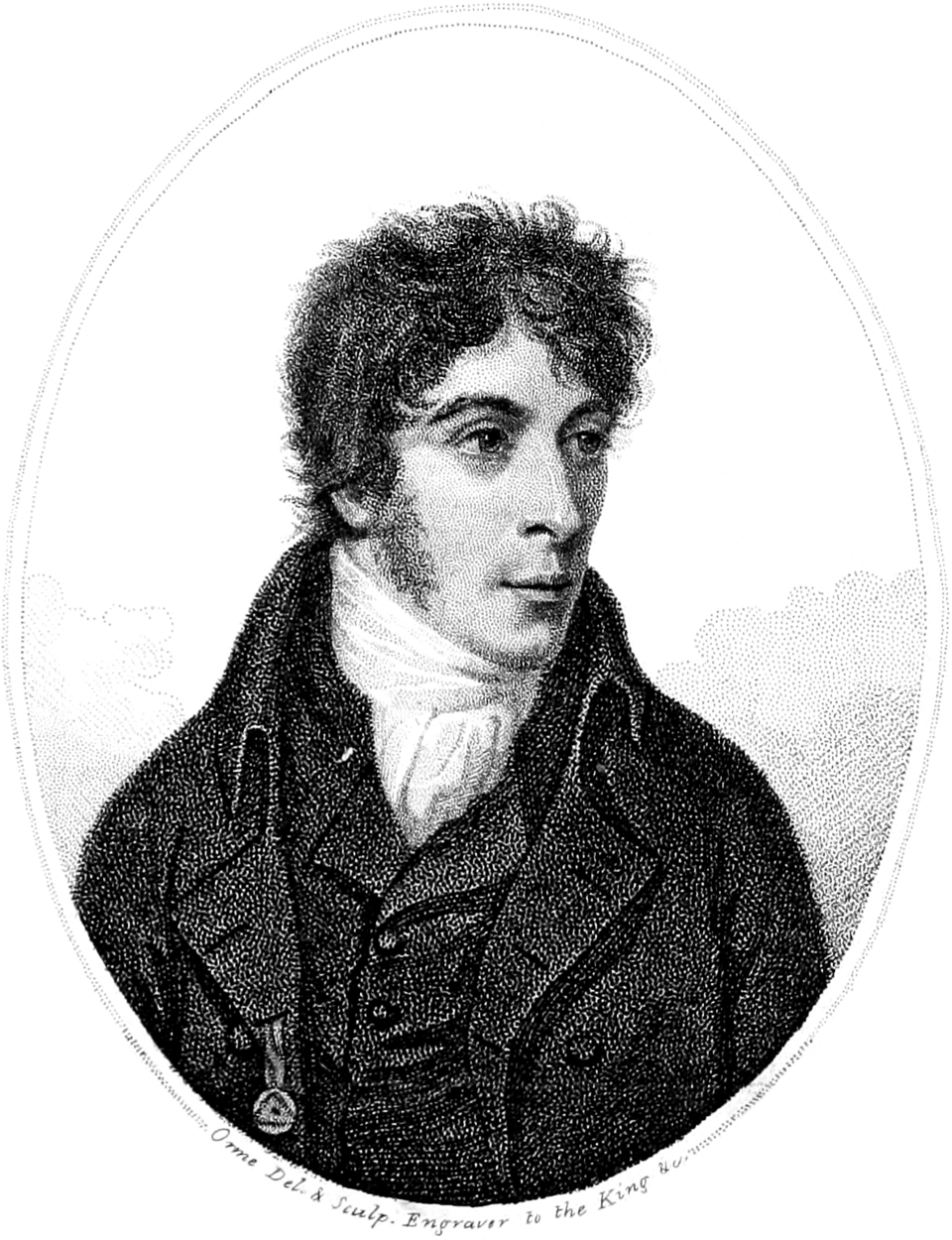
The Magus, or Celestial Intelligencer
Francis Barrett · 1801 · English
Barrett reproduces the construction for a nineteenth-century readership.
Read The Magus, or Celestial Intelligencer in full ↗Cover: Public domain · Unknown author · Wikimedia file page
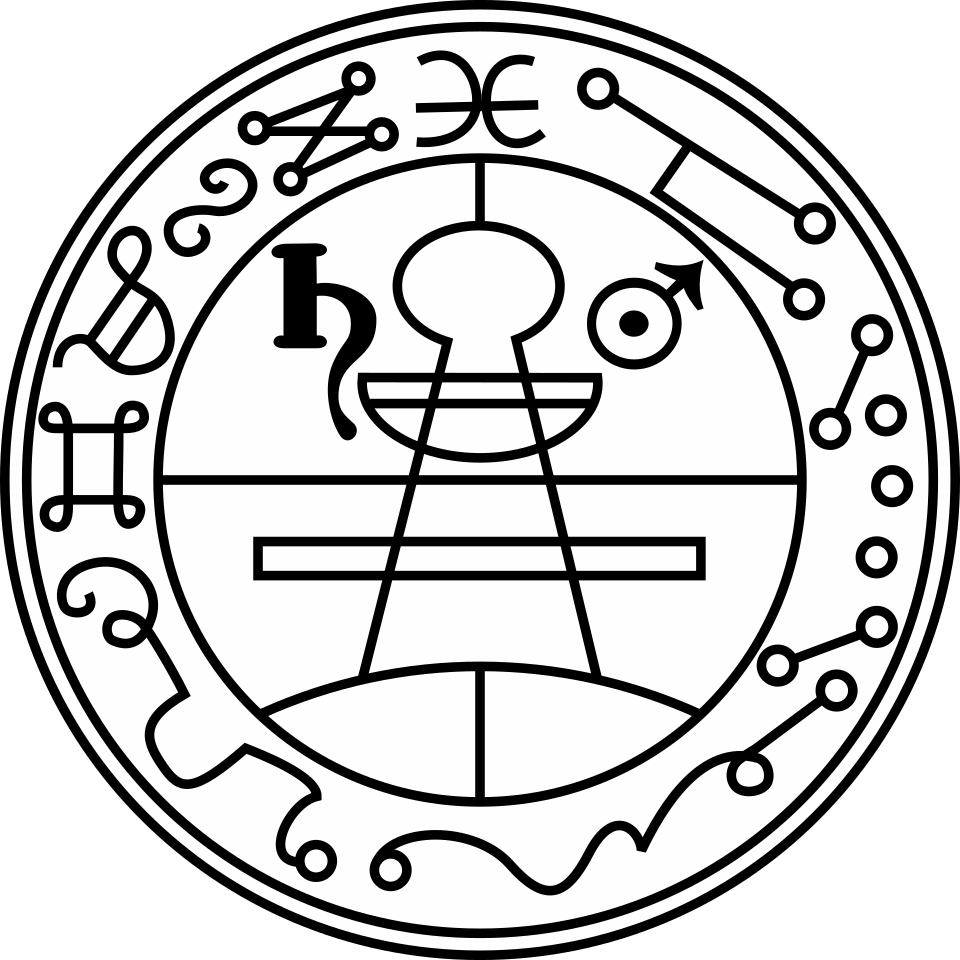
The Lesser Key of Solomon, Book I: Ars Goetia
Anonymous; ed. S. L. MacGregor Mathers & A. E. Waite · 17th c.; ed. 1904 · English (from Latin)
Worn at the breast and shown to the spirit; carries the spirit's own seal.
Read The Lesser Key of Solomon, Book I: Ars Goetia in full ↗Cover: Public domain · anonymous design, redrawn by User:Fuzzypeg · Wikimedia file page
Nearby
Related marks
The Tetragrammaton
Four letters that stopped being pronounced and became, in consequence, the most powerful thing you could write on a piece of equipment.
The Brass Vessel
The container the legend says Solomon sealed the spirits into, thrown into a lake and opened by Babylonians who expected treasure. It is where the Ars Goetia says its seventy-two came from.
AGLA
An acronym, not a word: Atah Gibor Le-olam Adonai, 'Thou art mighty forever, Lord', compressed to four letters and written on almost everything.
The Celestial Alphabets
Three alphabets Agrippa prints for writing the names of angels — Hebrew letters redrawn with rings at the joints, so that a script becomes a set of sigils.
The Pentagram
A five-pointed star drawn in one unbroken line — an accounting mark, a Pythagorean password, a Christian emblem of the five wounds, and only recently a sign of evil.
The Bronze Serpent
A healing standard that stood in the Temple for centuries until a reforming king smashed it — the Hebrew Bible's own account of a symbol going wrong.