geometric · carved c. 3200 BCE
The Triple Spiral
Three joined spirals cut into a kerbstone at Newgrange five thousand years ago — older than the pyramids, and completely unexplained.
What the sources claim for it
Unknown, and unrecoverable. The one thing the site is confident of is the midwinter alignment of the building it is carved in.
History
Where does the Triple Spiral come from?
The triple spiral is carved on the entrance stone and inside the chamber at Newgrange, a passage tomb built around 3200 BCE and aligned so that the rising sun at midwinter enters the passage and lights the chamber floor. The alignment is beyond doubt; the meaning of the carving is not recoverable at all.
It is the oldest mark on this site, and the one about which least can honestly be said. The people who cut it left no writing, and the Celtic-speaking cultures usually credited with it arrived in Ireland more than two thousand years later. Every reading offered — three realms, three phases, a triple goddess — is modern.
Afterwards
What did it turn into?
Adopted as a general Celtic and modern pagan emblem, routinely captioned with meanings invented in the twentieth century for a carving that predates the Celts entirely.
Which texts describe it?
Oldest first, with what each one does with the mark. A mark described in a Bronze Age incantation and a mark first drawn in a seventeenth-century manuscript are different kinds of claim, whatever the shape has in common.
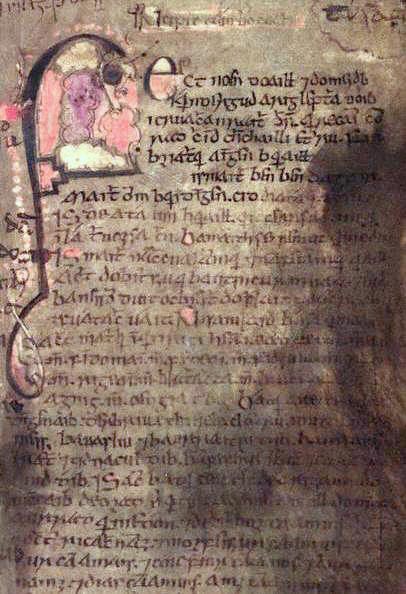
Lebor Gabála Érenn & the Mythological Cycle
Anonymous Irish monastics · 11th c., from older oral material · Middle Irish
The medieval Irish pseudo-history that later tradition reads back onto these monuments — written four thousand years after the carving.
Read Lebor Gabála Érenn & the Mythological Cycle in full ↗Cover: Public domain · Áed Ua Crimthainn et al (12th century) · Wikimedia file page
Nearby
Related marks
Ogham
Notches cut across the edge of a standing stone — an alphabet designed to be written on a corner rather than a face.
The Triquetra
Three interlaced arcs from Insular manuscript art — read as the Trinity by the people who drew it, and as pre-Christian by nearly everyone since.
The Pentagram
A five-pointed star drawn in one unbroken line — an accounting mark, a Pythagorean password, a Christian emblem of the five wounds, and only recently a sign of evil.
The Ouroboros
A serpent swallowing its own tail, first drawn around the sun god in an Egyptian tomb and still in use three thousand years later as a diagram of a closed system.
The Eight Trigrams
Eight stacks of three broken or unbroken lines — a complete three-bit notation, arranged in a ring and hung over doorways.
The Dharmachakra
An eight-spoked wheel for an eightfold path — the emblem Buddhism used for its founder for four centuries before it would depict him at all.