divine name · c. 350–600 CE
Ogham
Notches cut across the edge of a standing stone — an alphabet designed to be written on a corner rather than a face.
What the sources claim for it
In the surviving inscriptions, ownership and lineage. The esoteric readings are medieval or modern.
History
Where does Ogham come from?
Ogham is a real script for early Irish, written as groups of one to five strokes cut across or beside a stem line, which on monuments is the vertical edge of the stone itself. Around four hundred inscriptions survive, mostly in Ireland and Wales, and mostly personal names in the genitive: this is the stone of X, son of Y.
The letters carry tree names in the medieval manuscript tradition, which is where the 'tree alphabet' idea comes from — though the naming is later than the script and not all of the names are trees. Robert Graves' The White Goddess of 1948 built an elaborate calendar on that association, and it is his invention, not a Celtic one.
Afterwards
What did it turn into?
The Graves calendar is the source of nearly all modern 'Celtic tree astrology', and is repeated as ancient in a large popular literature.
Which texts describe it?
Oldest first, with what each one does with the mark. A mark described in a Bronze Age incantation and a mark first drawn in a seventeenth-century manuscript are different kinds of claim, whatever the shape has in common.
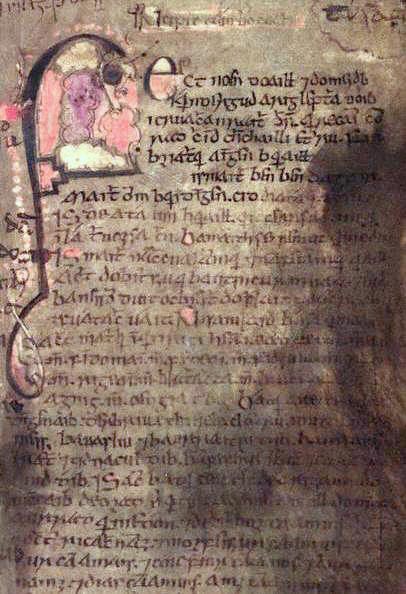
Lebor Gabála Érenn & the Mythological Cycle
Anonymous Irish monastics · 11th c., from older oral material · Middle Irish
The medieval Irish learned tradition that transmits the letter names and their glosses.
Read Lebor Gabála Érenn & the Mythological Cycle in full ↗Cover: Public domain · Áed Ua Crimthainn et al (12th century) · Wikimedia file page
Nearby
Related marks
The Triple Spiral
Three joined spirals cut into a kerbstone at Newgrange five thousand years ago — older than the pyramids, and completely unexplained.
The Triquetra
Three interlaced arcs from Insular manuscript art — read as the Trinity by the people who drew it, and as pre-Christian by nearly everyone since.
Om
A syllable before it was ever a shape — recited at the opening and close of Vedic utterance, and only much later written as the mark everyone recognises.
The Tetragrammaton
Four letters that stopped being pronounced and became, in consequence, the most powerful thing you could write on a piece of equipment.
The Ephesia Grammata
Six meaningless Greek words, said to have been written on the statue of Artemis at Ephesus, and spoken or worn as protection for a thousand years.
The Sator Square
Five Latin words in a grid that reads the same in four directions, scratched on a wall at Pompeii and still being cut into churches a thousand years later.