divine name · attested from c. 400 BCE
The Ephesia Grammata
Six meaningless Greek words, said to have been written on the statue of Artemis at Ephesus, and spoken or worn as protection for a thousand years.
What the sources claim for it
Words whose power is held to lie in their sound and their strangeness, not their sense. Speaking them is an act rather than a statement.
History
Where does the Ephesia Grammata come from?
Six short words, reported by ancient authors as the Ephesian letters and not reproduced here. What they mean is unknown, and that is the point: the sources that record them already disagree, and they were opaque to the Greeks who used them. They turn up on lead tablets, on gemstones, in comedy as a joke about superstition, and in the Greek magical papyri among the long strings of vowels and nonsense syllables that scholarship calls voces magicae.
They belong at the head of a line the corpus follows all the way to the grimoires. Language that has stopped meaning anything is treated as more powerful rather than less, because the operator can no longer be accused of merely asking. That principle carries the Egyptian and Hebrew fragments in the papyri, the untranslated names on the Solomonic circle, and Enochian in the sixteenth century.
1 figure
Who is it attached to?
Figures it is used against
The mark is aimed at them. A ward names its target, which makes these the sharpest attributions on the page.
Afterwards
What did it turn into?
The direct ancestor of every made-up magical word in later practice and fiction, and the reason a grimoire full of unreadable names looks authoritative rather than incompetent to its own readers.
Which texts describe it?
Oldest first, with what each one does with the mark. A mark described in a Bronze Age incantation and a mark first drawn in a seventeenth-century manuscript are different kinds of claim, whatever the shape has in common.
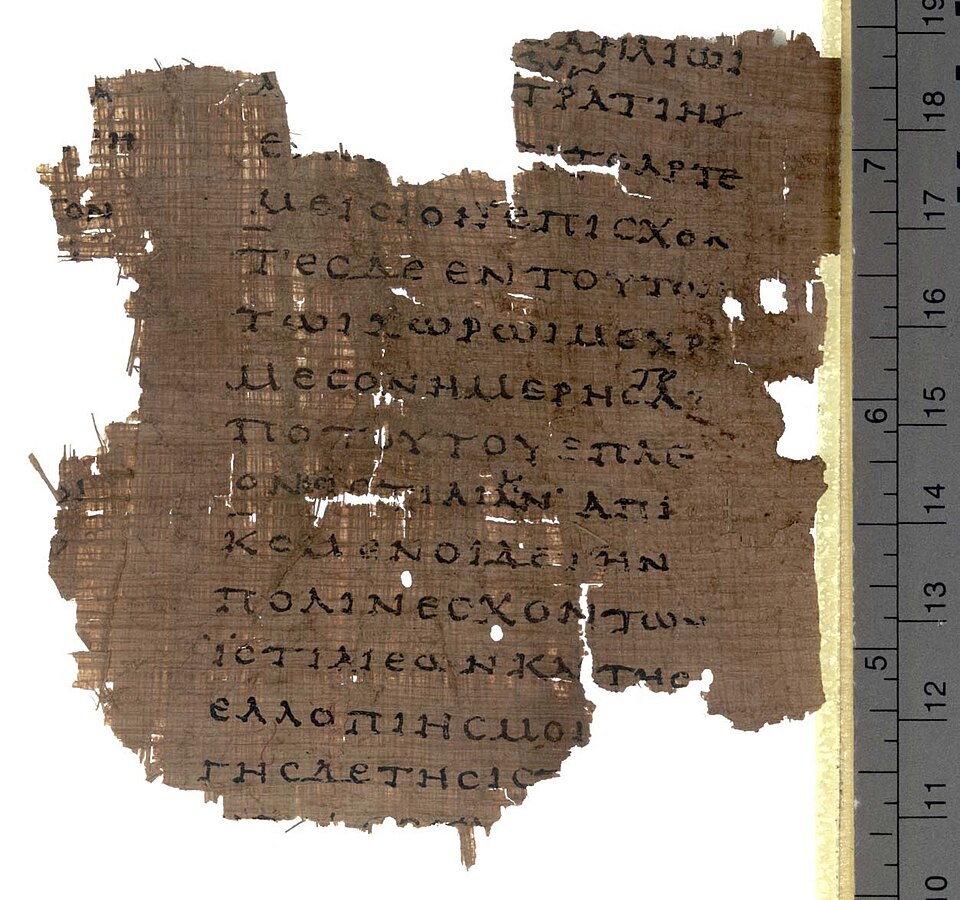
The Histories, Book II
Herodotus; tr. G. C. Macaulay · c. 430 BCE · Ancient Greek
The Greek world these formulae circulate in, and its reporting of foreign rites.
Read The Histories, Book II in full ↗Cover: Public domain · Unknown · Wikimedia file page
The Magus, or Celestial Intelligencer
Francis Barrett · 1801 · English
The later Latin tradition of barbarous names Barrett is still copying.
Read The Magus, or Celestial Intelligencer in full ↗Cover: Public domain · Unknown author · Wikimedia file page
Nearby
Related marks
The Gorgoneion
A severed monster's face on a shield, a roof tile, an oven and a coin — the most-produced apotropaic image of the ancient Mediterranean.
The Hand of Sabazios
A bronze right hand raised in blessing, crowded with small figures — a pine cone, a snake, a frog, a lizard — mounted on a pole and carried in the rites of a Thracian god at Rome.
The Pentagram
A five-pointed star drawn in one unbroken line — an accounting mark, a Pythagorean password, a Christian emblem of the five wounds, and only recently a sign of evil.
The Swastika
An auspicious mark used continuously for four and a half thousand years across most of the world, and destroyed as a public sign in the West by twelve years of one European party's use of it.
The Nazar
Blue glass with a white and black eye at its centre, worn on the theory that a look can be sent back.
The Caduceus
Two snakes twined on a winged staff — the badge of a herald under safe conduct, and, through a filing error, the emblem of American military medicine.