protective · c. 800–550 BCE
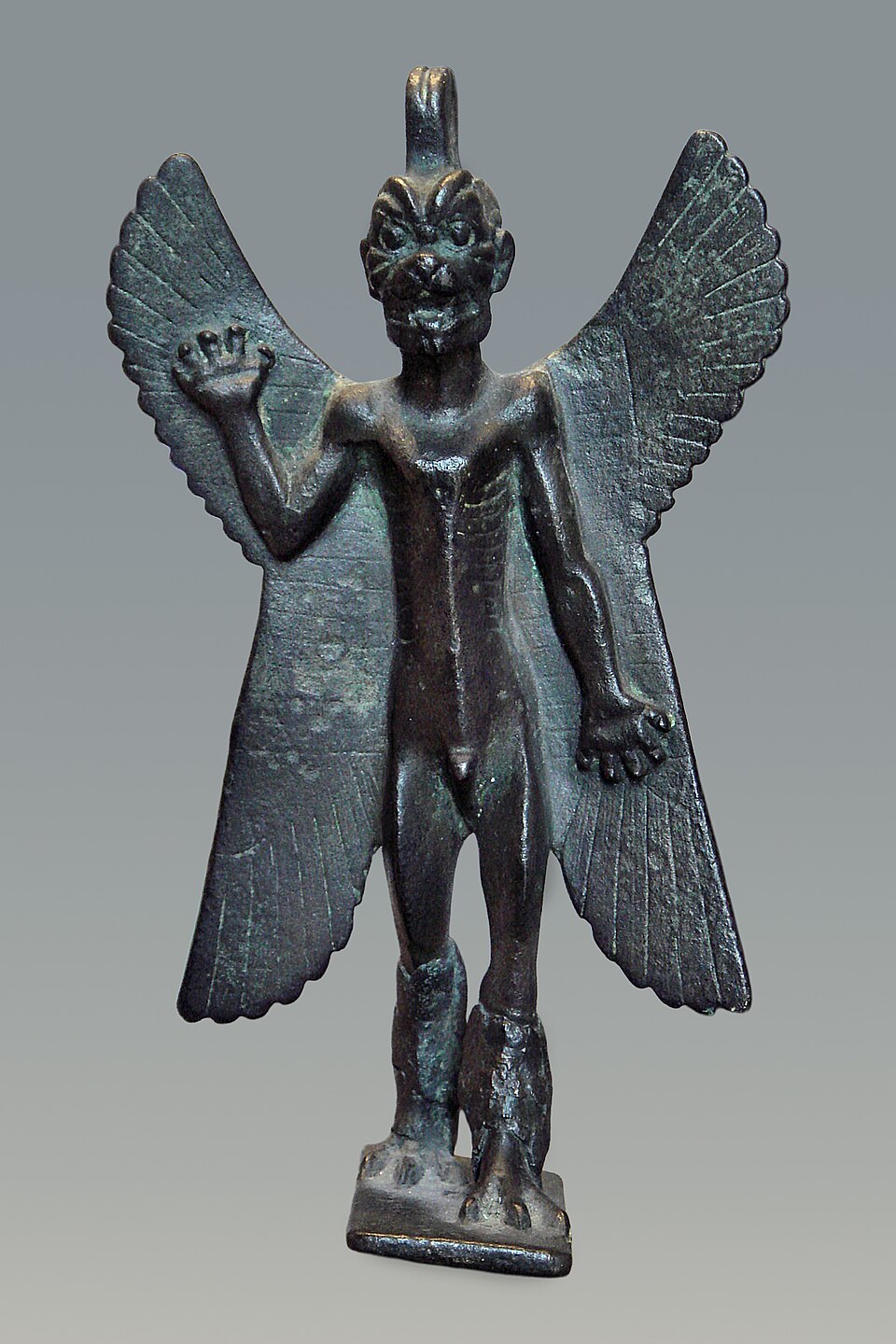
The Pazuzu Head
A demon's face worn to keep a demon out — the clearest surviving case of a malevolent spirit hired as a doorman.
What the sources claim for it
Protection by rivalry. The threat to the household is repelled by a worse thing that happens to be its enemy.
What is it made of?
A composite body, and every element of it is a statement about what the figure can do.
Lion's head
Four wings
Talons
The inscription
on the back
Pazuzu Head
- 01
Lion's head — A snarling face, teeth bared. Apotropaic by ugliness — the thing at the door is meant to be worse than the thing outside it.
- 02
Four wings — Two pairs, marking him as a wind demon: the south-west wind that brings fever and locusts.
- 03
Talons — Bird's feet, on a human torso, with a scorpion's tail behind. Nothing about the figure is one animal.
- 04
The inscription · on the back — 'I am Pazuzu, son of Hanpa, king of the evil wind-spirits' — the amulet states its own name.
History
Where does the Pazuzu Head come from?
First-millennium Mesopotamian households produced small bronze heads of Pazuzu, pierced for suspension, and bronze plaques showing Lamashtu driven back toward the underworld with Pazuzu's head peering over the top edge. They were hung at doorways and worn at the neck, and they cluster around childbirth, which is exactly where Lamashtu was believed to attack.
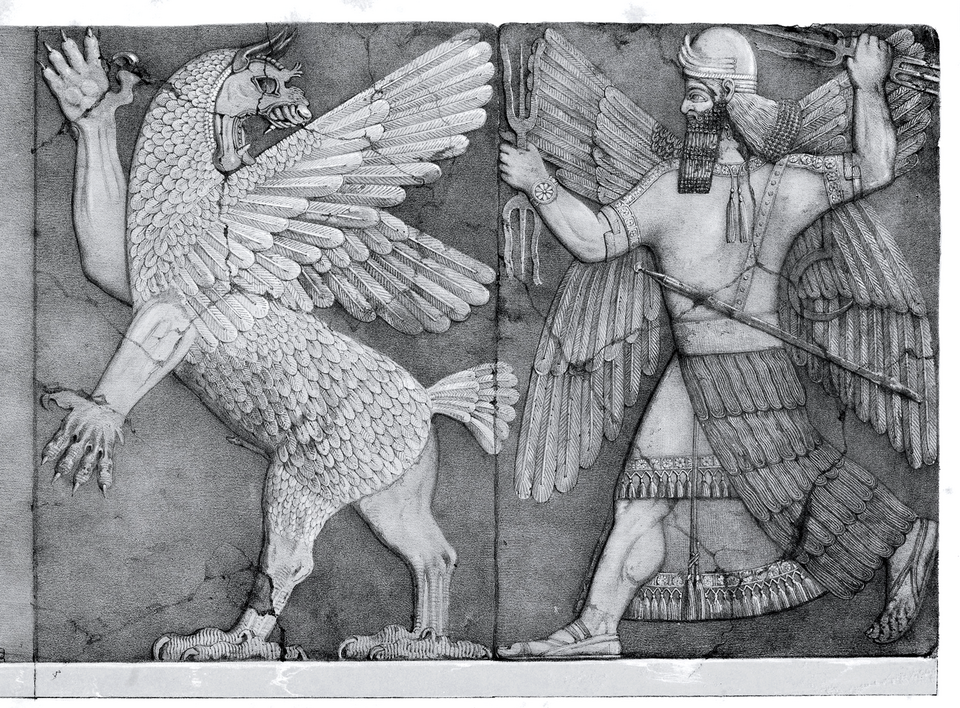
The logic is not that Pazuzu is benevolent. He is a wind demon associated with fever and destructive weather, and the incantations do not pretend otherwise. He is used because he is stronger than Lamashtu and hostile to her. An amulet of this kind is applied demonology rather than piety.
2 figures
Who is it attached to?
Figures who carry it
An attribute rather than a signature — held, worn or associated in the texts and the images.
Figures it is used against
The mark is aimed at them. A ward names its target, which makes these the sharpest attributions on the page.
The larger argument
Why is it in a corpus about spirits?
The single most important idea on the protective side of this corpus: the ward is itself a demon. Pazuzu is not set against Lamashtu because he is good but because he is stronger and can be aimed. Every later system that binds a spirit to work — Solomon's demons building the Temple, the Goetia's spirits finding treasure — is running this logic a thousand years downstream.
Afterwards
What did it turn into?
The 1973 film The Exorcist opens with the excavation of a Pazuzu figure, which turned an Assyrian household ward into the twentieth century's default image of demonic possession — a role no ancient text gives it.
Which texts describe it?
Oldest first, with what each one does with the mark. A mark described in a Bronze Age incantation and a mark first drawn in a seventeenth-century manuscript are different kinds of claim, whatever the shape has in common.

Akkadian Incantation Series & Amulet Inscriptions
Anonymous; recovered from Assyrian and Babylonian sites · c. 1800-600 BCE · Akkadian and Sumerian
Incantations against Lamashtu accompany the plaques and state what they are for.
Read Akkadian Incantation Series & Amulet Inscriptions in full ↗Cover: Public domain · Robert William Rogers (1864–1930) · Wikimedia file page
Nearby
Related marks
The Incantation Bowl
A plain clay bowl with writing spiralling inward across the inside, buried upside down under the floor of a house. Around two thousand survive, and they name demons by name.
The Pentagram
A five-pointed star drawn in one unbroken line — an accounting mark, a Pythagorean password, a Christian emblem of the five wounds, and only recently a sign of evil.
The Star of Ishtar
Eight points for the planet Venus, and the standard way of writing a goddess into a scene without drawing her.
The Winged Disc
A sun with wings, borrowed by every empire in the region in turn — and the direct ancestor of the Persian faravahar.
The Swastika
An auspicious mark used continuously for four and a half thousand years across most of the world, and destroyed as a public sign in the West by twelve years of one European party's use of it.
The Standing Stone
An upright unworked stone marking a place where something happened — the oldest kind of monument, and one the Bible both erects and forbids.