protective · attested at Qumran, c. 100 BCE
The Mezuzah
A rolled parchment in a case on a doorpost, containing the verses that instruct you to put it there.
What the sources claim for it
Obedience to a specific command, at the boundary of the home. Any protective reading is contested from within.
History
Where does the Mezuzah come from?
Deuteronomy tells Israel to write these words on the doorposts of your house and on your gates, and the mezuzah is that instruction carried out literally: a hand-written parchment bearing the Shema passages, rolled, cased, and fixed at an angle to the right-hand doorpost. Examples from Qumran show the practice is at least two thousand years old.
Whether it is a ward is a live internal argument. Maimonides is sharp about it — anyone who treats the mezuzah as an amulet for personal benefit has lost the point, which is the remembrance of God at every threshold. Popular practice has consistently treated it as protective anyway, and medieval examples sometimes add angel names, which the halakhic authorities disapproved of.
Afterwards
What did it turn into?
Universal in observant Jewish homes and common in secular Israeli ones; the case has become a significant craft and design object in its own right.
Which texts describe it?
Oldest first, with what each one does with the mark. A mark described in a Bronze Age incantation and a mark first drawn in a seventeenth-century manuscript are different kinds of claim, whatever the shape has in common.
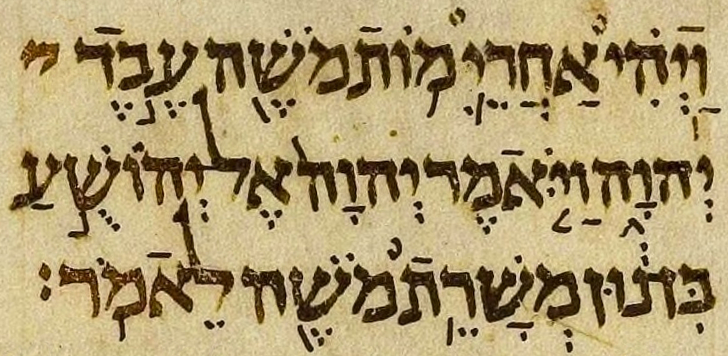
Hebrew Bible & Deuterocanon
Various · c. 900–100 BCE · Hebrew, Aramaic, Greek
Deuteronomy 6 and 11 — the passages written on the parchment are the ones commanding it.
Read Hebrew Bible & Deuterocanon in full ↗Cover: Public domain · see en:Aleppo Codex; scanned by · Wikimedia file page

Mishneh Torah, Yesodei ha-Torah
Moses Maimonides · c. 1180 · Hebrew
Maimonides codifies the practice and rejects the amuletic reading of it.
Read Mishneh Torah, Yesodei ha-Torah in full ↗Cover: Public domain · Blaisio Ugolino · Wikimedia file page
Nearby
Related marks
The Standing Stone
An upright unworked stone marking a place where something happened — the oldest kind of monument, and one the Bible both erects and forbids.
The Bull
The standard way of saying a god is strong — and, at Sinai and at Bethel, the standard way of getting it wrong.
The Asherah Pole
A wooden pole or stylised tree beside an altar, mentioned about forty times in the Hebrew Bible and almost always in the course of ordering its destruction.
The Tetragrammaton
Four letters that stopped being pronounced and became, in consequence, the most powerful thing you could write on a piece of equipment.
The Bronze Serpent
A healing standard that stood in the Temple for centuries until a reforming king smashed it — the Hebrew Bible's own account of a symbol going wrong.
The Menorah
A seven-branched lampstand specified to the almond blossom in Exodus, and carved on a Roman arch as loot.