divine name · in Christian use from the 2nd century CE
The Cross
An instrument of public execution adopted as the emblem of the executed — and avoided in Christian art for as long as the punishment was still in use.
What the sources claim for it
The execution, claimed as a victory. In the signing gesture, protection by association with it.
History
Where does the Cross come from?
Crucifixion was a Roman penalty for slaves, rebels and pirates, designed to be humiliating and public. Early Christian art is correspondingly reticent: the fish, the anchor, the chi-rho and the shepherd carry the identity for the first three centuries, and the earliest surviving depiction of the crucifixion is a piece of second- or third-century graffiti mocking a Christian for worshipping a crucified donkey-headed figure.
The cross becomes the dominant sign after Constantine, and crucifixion is abolished as a punishment during the fourth century. Those two facts are related. A symbol whose referent is a currently operating gallows is a different object from one whose referent is a historical event, and the shift in Christian art tracks the change closely.
In use, the sign is made as well as displayed: signing the cross over a person, a place or oneself is attested from the second century as a protective and consecratory gesture, which puts it in the same functional category as the wards elsewhere in this corpus.
Afterwards
What did it turn into?
Now the most widely displayed religious symbol on earth, and the ancestor of an enormous family of variants — Latin, Greek, Tau, saltire, patriarchal — each of which acquired its own regional and institutional loading.
Which texts describe it?
Oldest first, with what each one does with the mark. A mark described in a Bronze Age incantation and a mark first drawn in a seventeenth-century manuscript are different kinds of claim, whatever the shape has in common.
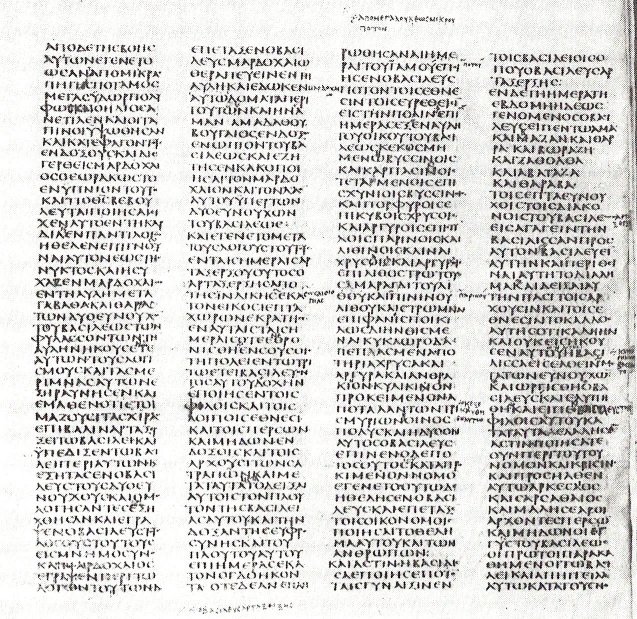
New Testament
Various · c. 50–110 CE · Koine Greek
The execution the sign refers to, and the earliest theological readings of it.
Read New Testament in full ↗Cover: Public domain · Wikimedia file page
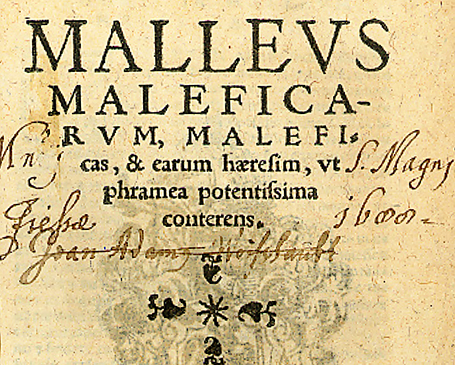
Malleus Maleficarum
Heinrich Kramer and Jacob Sprenger · 1487 · Latin
The sign of the cross assumed throughout as a defence against demonic assault.
Read Malleus Maleficarum in full ↗Cover: Public domain · Unknown author · Wikimedia file page
Nearby
Related marks
The Pentagram
A five-pointed star drawn in one unbroken line — an accounting mark, a Pythagorean password, a Christian emblem of the five wounds, and only recently a sign of evil.
The Tetragrammaton
Four letters that stopped being pronounced and became, in consequence, the most powerful thing you could write on a piece of equipment.
The Bronze Serpent
A healing standard that stood in the Temple for centuries until a reforming king smashed it — the Hebrew Bible's own account of a symbol going wrong.
The Sator Square
Five Latin words in a grid that reads the same in four directions, scratched on a wall at Pompeii and still being cut into churches a thousand years later.
Alpha and Omega
First and last letters of the Greek alphabet, used in Revelation as a name — a claim about extent made out of the ordering of a writing system.
The Number of the Beast
A number given in Revelation as a puzzle with a stated solution method — 'let him that hath understanding count' — and now the single most recognisable mark in the whole subject.