divine name · c. 95 CE
Alpha and Omega
First and last letters of the Greek alphabet, used in Revelation as a name — a claim about extent made out of the ordering of a writing system.
What the sources claim for it
Totality of time and being, stated as the span of an alphabet.
What is it made of?
The first and last letters of the Greek alphabet, used to say a whole range by naming only its ends.
Alpha
first
Omega
last
Alpha and Omega
- 01
Alpha · first — In Revelation, the speaker's claim to be the beginning.
- 02
Omega · last — The end of the same claim: 'I am the Alpha and the Omega'.
History
Where does Alpha and Omega come from?
Revelation puts the phrase in the mouth of God and of Christ — I am the Alpha and the Omega, the beginning and the end — and Christian art picks it up quickly, usually flanking a chi-rho or a cross, on catacomb painting, mosaics and coinage.
It is an unusually compact piece of theology. The claim is about extent rather than attribute, and it is made using the order of an alphabet rather than any image, which makes it one of the very few symbols in this corpus that is intrinsically untranslatable: it only works in Greek.
The larger argument
Why is it in a corpus about spirits?
A merism — naming two extremes to mean everything between them — which is the same figure of speech the Hebrew Bible uses in 'the heavens and the earth'. In the operative texts it becomes a way of writing totality onto an instrument, and it travels on circles and pentacles beside the divine names for exactly that reason.
Afterwards
What did it turn into?
Continuous in Christian liturgical art for nineteen centuries, and one of the few early Christian symbols that never acquired an occult second life.
Which texts describe it?
Oldest first, with what each one does with the mark. A mark described in a Bronze Age incantation and a mark first drawn in a seventeenth-century manuscript are different kinds of claim, whatever the shape has in common.
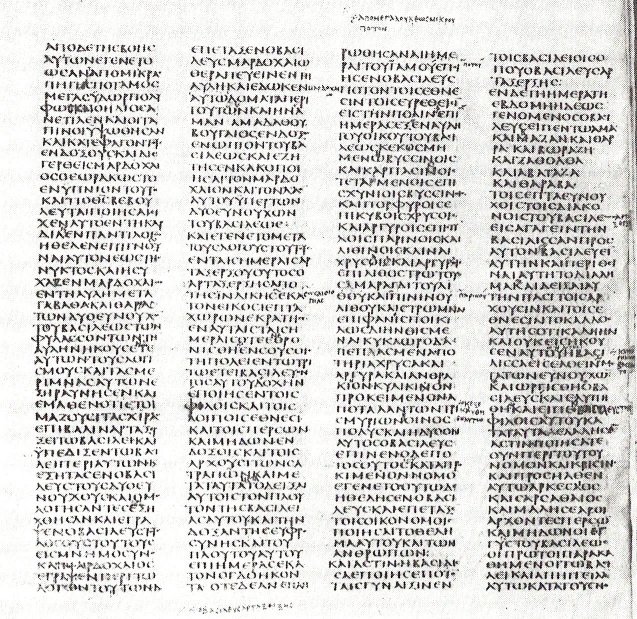
New Testament
Various · c. 50–110 CE · Koine Greek
Revelation 1:8 and 22:13.
Read New Testament in full ↗Cover: Public domain · Wikimedia file page
Nearby
Related marks
The Pentagram
A five-pointed star drawn in one unbroken line — an accounting mark, a Pythagorean password, a Christian emblem of the five wounds, and only recently a sign of evil.
The Tetragrammaton
Four letters that stopped being pronounced and became, in consequence, the most powerful thing you could write on a piece of equipment.
The Bronze Serpent
A healing standard that stood in the Temple for centuries until a reforming king smashed it — the Hebrew Bible's own account of a symbol going wrong.
The Sator Square
Five Latin words in a grid that reads the same in four directions, scratched on a wall at Pompeii and still being cut into churches a thousand years later.
The Number of the Beast
A number given in Revelation as a puzzle with a stated solution method — 'let him that hath understanding count' — and now the single most recognisable mark in the whole subject.
The Ichthys
Two arcs making a fish, standing for an acrostic — ΙΧΘΥΣ, 'Jesus Christ, God's Son, Saviour'. A symbol that is really a sentence.