divine name · 2nd century CE
The Ichthys
Two arcs making a fish, standing for an acrostic — ΙΧΘΥΣ, 'Jesus Christ, God's Son, Saviour'. A symbol that is really a sentence.
What the sources claim for it
A creed compressed to five letters, and then to two lines.
What is it made of?
An acrostic hiding inside a fish: the Greek word ΙΧΘΥΣ, read one letter at a time as the initials of a creed.
Iota
Iēsous
Chi
Christos
Theta
Theou
Upsilon
Huios
Sigma
Sōtēr
Ichthys
- 01
Iota · Iēsous — Jesus.
- 02
Chi · Christos — Christ.
- 03
Theta · Theou — of God.
- 04
Upsilon · Huios — Son.
- 05
Sigma · Sōtēr — Saviour.
History
Where does the Ichthys come from?
The Greek word for fish, ichthys, spells out an acrostic confession of faith, and second-century Christian sources treat the pun as meaningful rather than accidental. The drawn form is about as minimal as a symbol can be: two intersecting curves, producible in a second with a stick.
That minimalism is usually explained as covertness, and it may partly be, though the fish appears openly on Christian tombs and rings well before toleration. What it certainly is, is cheap and fast to make and instantly legible to anyone who already knows the acrostic — the practical profile of an identity marker rather than a ritual instrument.
The larger argument
Why is it in a corpus about spirits?
The same compression that produces AGLA, running in Greek and in a Christian setting. It is worth reading beside AGLA on purpose: one acrostic stays a confession of faith and the other becomes a name of God written on magical equipment, and nothing in the technique decides which way it goes — the tradition receiving it does.
Afterwards
What did it turn into?
Revived in the 1970s as a car-bumper emblem and answered by parody variants — the Darwin fish and its successors — a rare case of a two-thousand-year-old symbol acquiring an active counter-symbol.
Which texts describe it?
Oldest first, with what each one does with the mark. A mark described in a Bronze Age incantation and a mark first drawn in a seventeenth-century manuscript are different kinds of claim, whatever the shape has in common.
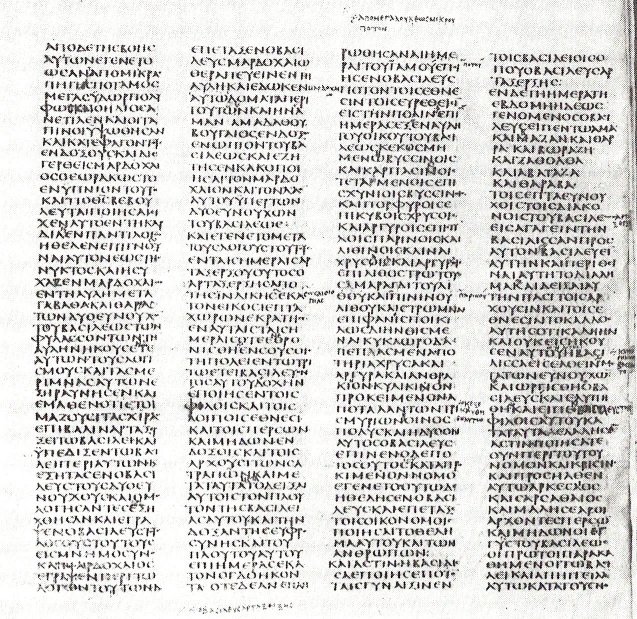
New Testament
Various · c. 50–110 CE · Koine Greek
The acrostic's terms are drawn from the New Testament's confessional formulas.
Read New Testament in full ↗Cover: Public domain · Wikimedia file page
Nearby
Related marks
The Pentagram
A five-pointed star drawn in one unbroken line — an accounting mark, a Pythagorean password, a Christian emblem of the five wounds, and only recently a sign of evil.
The Tetragrammaton
Four letters that stopped being pronounced and became, in consequence, the most powerful thing you could write on a piece of equipment.
The Bronze Serpent
A healing standard that stood in the Temple for centuries until a reforming king smashed it — the Hebrew Bible's own account of a symbol going wrong.
The Sator Square
Five Latin words in a grid that reads the same in four directions, scratched on a wall at Pompeii and still being cut into churches a thousand years later.
Alpha and Omega
First and last letters of the Greek alphabet, used in Revelation as a name — a claim about extent made out of the ordering of a writing system.
The Number of the Beast
A number given in Revelation as a puzzle with a stated solution method — 'let him that hath understanding count' — and now the single most recognisable mark in the whole subject.