What the sources claim for it
A warrant issued under a specific planetary authority. The verse is the citation, the divine names are the seal, and the hour is the jurisdiction.
History
Where does the Planetary Pentacles come from?
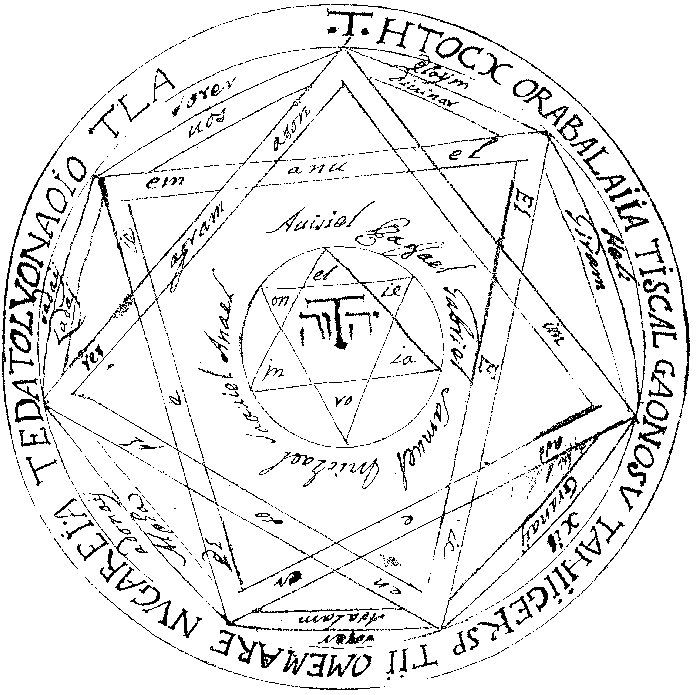
The Clavicula Salomonis distributes its authority across a set of pentacles rather than concentrating it in a ring: seven for Saturn, seven for Jupiter, seven for Mars, and so on down the planetary week. Each is a circle carrying a geometric figure, a ring of divine names in Hebrew, and a verse — normally a psalm — chosen to match the operation.
The construction rules matter more than the designs. A pentacle is to be made in the day and hour of its planet, in the metal or colour belonging to it, and consecrated before use. This is where the grimoire tradition becomes a craft tradition: what the operator makes is a legal instrument, and an instrument made at the wrong hour is void the way an unsigned document is void.
Afterwards
What did it turn into?
Mathers' 1889 English edition standardised the designs from a small group of British Library manuscripts, and effectively every pentacle reproduced since — in occult publishing, in film, on jewellery — descends from that one editorial choice.
Which texts describe it?
Oldest first, with what each one does with the mark. A mark described in a Bronze Age incantation and a mark first drawn in a seventeenth-century manuscript are different kinds of claim, whatever the shape has in common.
The Key of Solomon (Clavicula Salomonis)
Anonymous; ed. S. L. MacGregor Mathers · 15th-16th c. · Latin and Italian
The pentacles and their construction rules are the core of the text.
Read The Key of Solomon (Clavicula Salomonis) in full ↗Cover: Public domain · Unknown author · Wikimedia file page
The Magus, or Celestial Intelligencer
Francis Barrett · 1801 · English
Barrett reproduces the planetary figures for an English readership in 1801.
Read The Magus, or Celestial Intelligencer in full ↗Cover: Public domain · Unknown author · Wikimedia file page
Nearby
Related marks
The Tetragrammaton
Four letters that stopped being pronounced and became, in consequence, the most powerful thing you could write on a piece of equipment.
The Seal of Solomon
A signet ring, not a shape. The Testament of Solomon makes it the instrument by which every demon in the book is compelled to give its name.
The Brass Vessel
The container the legend says Solomon sealed the spirits into, thrown into a lake and opened by Babylonians who expected treasure. It is where the Ars Goetia says its seventy-two came from.
The Seventy-Two-Letter Name
Seventy-two three-letter names extracted from three verses of Exodus — and the reason the number seventy-two keeps appearing on both sides of this corpus.
AGLA
An acronym, not a word: Atah Gibor Le-olam Adonai, 'Thou art mighty forever, Lord', compressed to four letters and written on almost everything.
The Hexagram
Two interlocked triangles that were ornament almost everywhere before they were a Jewish emblem anywhere — and a spirit-binding seal in between.