divine name · from c. 300 CE
IHS
The first three letters of ΙΗΣΟΥΣ, read for centuries afterwards as the initials of a Latin sentence that was invented to explain them.
What the sources claim for it
The name of Christ, written short. Its authority is the name's, and the abbreviation carries no claim of its own.
History
Where does IHS come from?
IHS is a contraction, not an acronym: iota, eta, sigma, the first three letters of Jesus in Greek, abbreviated the way scribes abbreviated all the sacred names. It appears on Christian inscriptions from late antiquity and spreads through Latin Europe with the manuscripts.
Once the Greek was no longer read, the letters needed explaining, and Latin readers supplied expansions: Iesus Hominum Salvator, 'Jesus, saviour of mankind', or In Hoc Signo, from Constantine's vision. Both are back-formations. The monogram is promoted heavily by Bernardino of Siena in the fifteenth century and adopted as the emblem of the Jesuits, which is how a scribal shortcut became an order's coat of arms.
Afterwards
What did it turn into?
The invented Latin expansions are still printed on church furniture and repeated in guidebooks — the clearest small example on the site of a tradition explaining a mark it had stopped being able to read.
Which texts describe it?
Oldest first, with what each one does with the mark. A mark described in a Bronze Age incantation and a mark first drawn in a seventeenth-century manuscript are different kinds of claim, whatever the shape has in common.
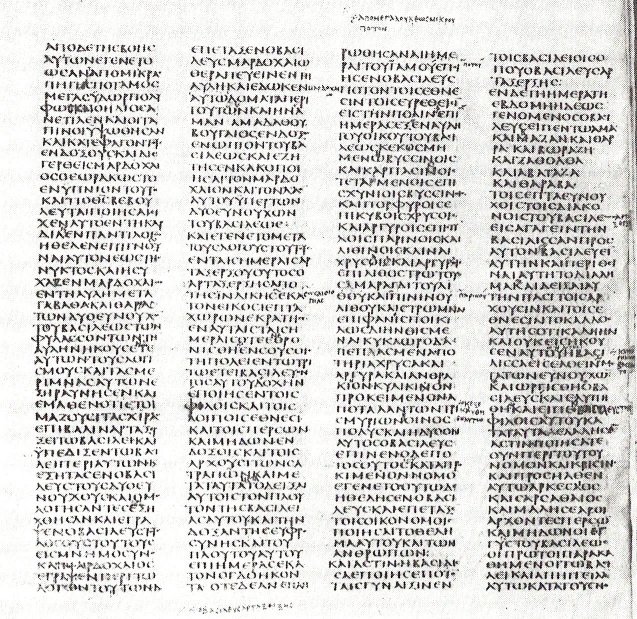
New Testament
Various · c. 50–110 CE · Koine Greek
The name being abbreviated; the contraction is scribal rather than textual.
Read New Testament in full ↗Cover: Public domain · Wikimedia file page
Nearby
Related marks
The Pentagram
A five-pointed star drawn in one unbroken line — an accounting mark, a Pythagorean password, a Christian emblem of the five wounds, and only recently a sign of evil.
The Tetragrammaton
Four letters that stopped being pronounced and became, in consequence, the most powerful thing you could write on a piece of equipment.
The Bronze Serpent
A healing standard that stood in the Temple for centuries until a reforming king smashed it — the Hebrew Bible's own account of a symbol going wrong.
The Sator Square
Five Latin words in a grid that reads the same in four directions, scratched on a wall at Pompeii and still being cut into churches a thousand years later.
Alpha and Omega
First and last letters of the Greek alphabet, used in Revelation as a name — a claim about extent made out of the ordering of a writing system.
The Number of the Beast
A number given in Revelation as a puzzle with a stated solution method — 'let him that hath understanding count' — and now the single most recognisable mark in the whole subject.