divine name · from 312 CE
The Chi-Rho
The first two letters of ΧΡΙΣΤΟΣ overlaid, put on a Roman army standard in 312 — the first Christian symbol with state power behind it.
What the sources claim for it
The name of Christ written as a monogram and, from 312, a claim of sanctioned victory.
What is it made of?
Two Greek letters — the first two of ΧΡΙΣΤΟΣ — overlaid rather than written in sequence.
Chi
CH
Rho
R
Combined
Chi-Rho
- 01
Chi · CH — The first letter of Christos, and a plain X to any Roman who did not already know what it stood for.
- 02
Rho · R — The second letter, laid over the upright of the chi so its loop sits at the top.
- 03
Combined — A scribal abbreviation before it is ever a banner. Its promotion to an army standard in 312 is political, not devotional.
History
Where does the Chi-Rho come from?
Chi and rho, the opening letters of Christos, combine into a monogram already in use as a scribal abbreviation. Its promotion is political: Constantine's forces carry it at the Milvian Bridge, and by the mid-fourth century it is on coinage, on sarcophagi, and on the labarum standard itself.
It marks the point where Christian symbolism moves from private identification to public authority. The cross, which the earliest Christians largely avoided depicting because crucifixion was a live and shameful punishment, becomes the dominant Christian sign only afterwards — once execution by crucifixion has been abolished within the empire.
The larger argument
Why is it in a corpus about spirits?
The Chi-Rho is the clearest case on the site of a mark acquiring state power, and it matters here because the tradition that later writes seals and circles is a Christian one operating inside an empire that had made this symbolism official. The equipment of the grimoires was assembled by people for whom a monogram carrying imperial authority was an ordinary sight.
Afterwards
What did it turn into?
Still standard in Western liturgical use, and the ancestor of the abbreviation 'Xmas', where the X is a chi rather than a deletion.
Which texts describe it?
Oldest first, with what each one does with the mark. A mark described in a Bronze Age incantation and a mark first drawn in a seventeenth-century manuscript are different kinds of claim, whatever the shape has in common.
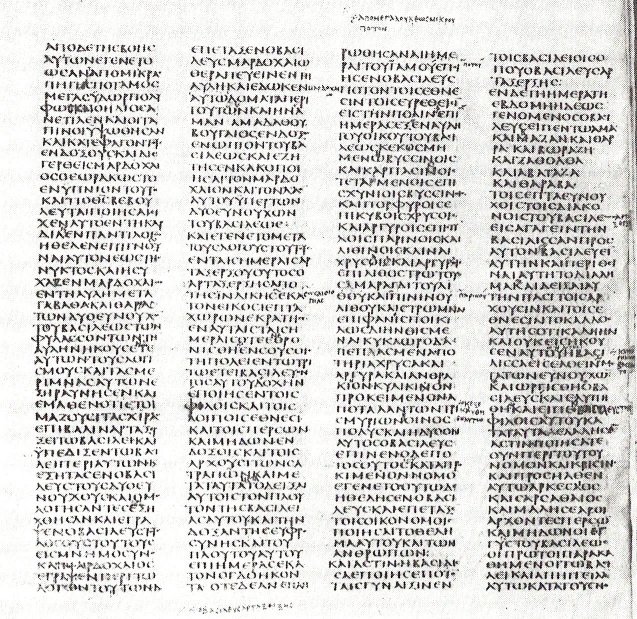
New Testament
Various · c. 50–110 CE · Koine Greek
Supplies the name; the monogram itself is a fourth-century development.
Read New Testament in full ↗Cover: Public domain · Wikimedia file page
Nearby
Related marks
The Pentagram
A five-pointed star drawn in one unbroken line — an accounting mark, a Pythagorean password, a Christian emblem of the five wounds, and only recently a sign of evil.
The Tetragrammaton
Four letters that stopped being pronounced and became, in consequence, the most powerful thing you could write on a piece of equipment.
The Bronze Serpent
A healing standard that stood in the Temple for centuries until a reforming king smashed it — the Hebrew Bible's own account of a symbol going wrong.
The Sator Square
Five Latin words in a grid that reads the same in four directions, scratched on a wall at Pompeii and still being cut into churches a thousand years later.
Alpha and Omega
First and last letters of the Greek alphabet, used in Revelation as a name — a claim about extent made out of the ordering of a writing system.
The Number of the Beast
A number given in Revelation as a puzzle with a stated solution method — 'let him that hath understanding count' — and now the single most recognisable mark in the whole subject.