protective · Viking age; worn from c. 900 CE
Mjölnir
The hammer that hallows — worn as silver pendants in exactly the century Christian cross pendants were spreading through the same region.
What the sources claim for it
Consecration and protection, with force as the visible half of it.
What is it made of?
A short-hafted hammer, and the shortness is in the myth: the dwarf smiths were interrupted, and the handle came out wrong.
The head
The short haft
The suspension loop
Mjölnir
- 01
The head — Square and heavy. Never depicted as a war-hammer in the amulets — it is a maker's tool doing consecration work.
- 02
The short haft — The flaw Loki caused, kept in the story and in every pendant cast from it.
- 03
The suspension loop — Over a thousand examples survive, worn at the neck — often, in the tenth century, from workshops also casting crosses.
History
Where does Mjölnir come from?
The Eddas make Mjölnir the definitive weapon against giants: dwarf-forged, with a handle that came out too short, returning to the hand when thrown. But its ritual use in the texts is not martial. It hallows. It is laid in the lap of a bride at a wedding, and it is used over the goats Thor cooks in order to bring them back to life.
The archaeology runs alongside. Hammer pendants appear across Scandinavia and the Danelaw from the ninth century, and at least one soapstone mould has been found that casts a hammer and a cross side by side — a craftsman serving a mixed market at the moment of conversion.
2 figures
Who is it attached to?
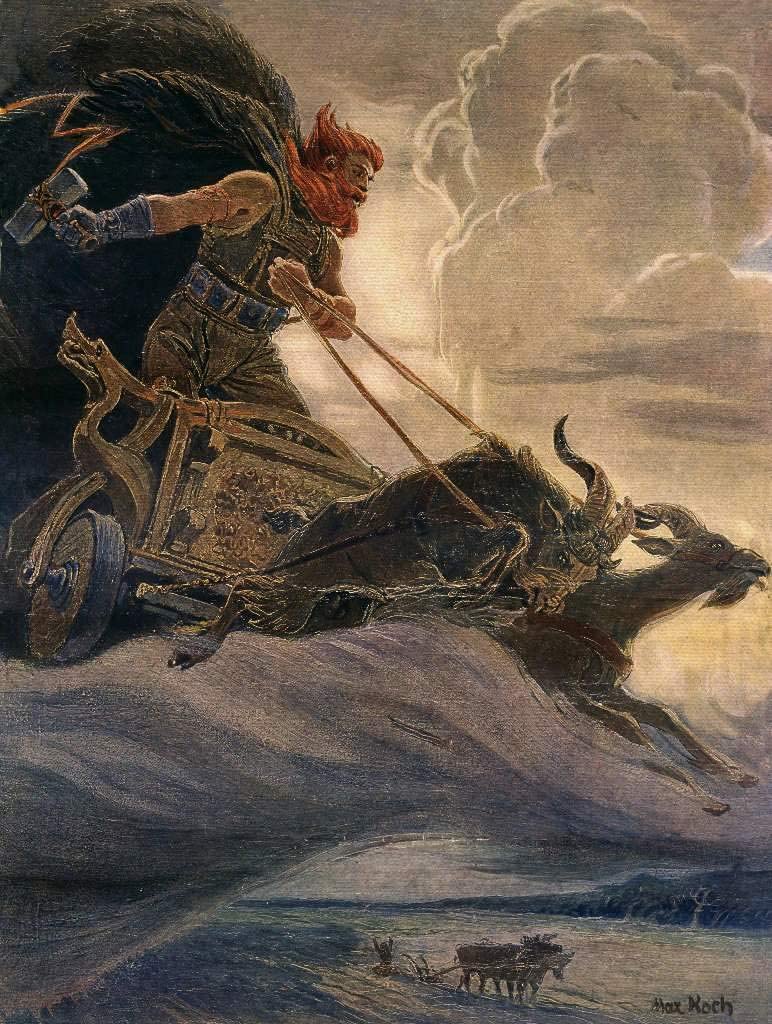
Figures who carry it
An attribute rather than a signature — held, worn or associated in the texts and the images.
Figures it is used against
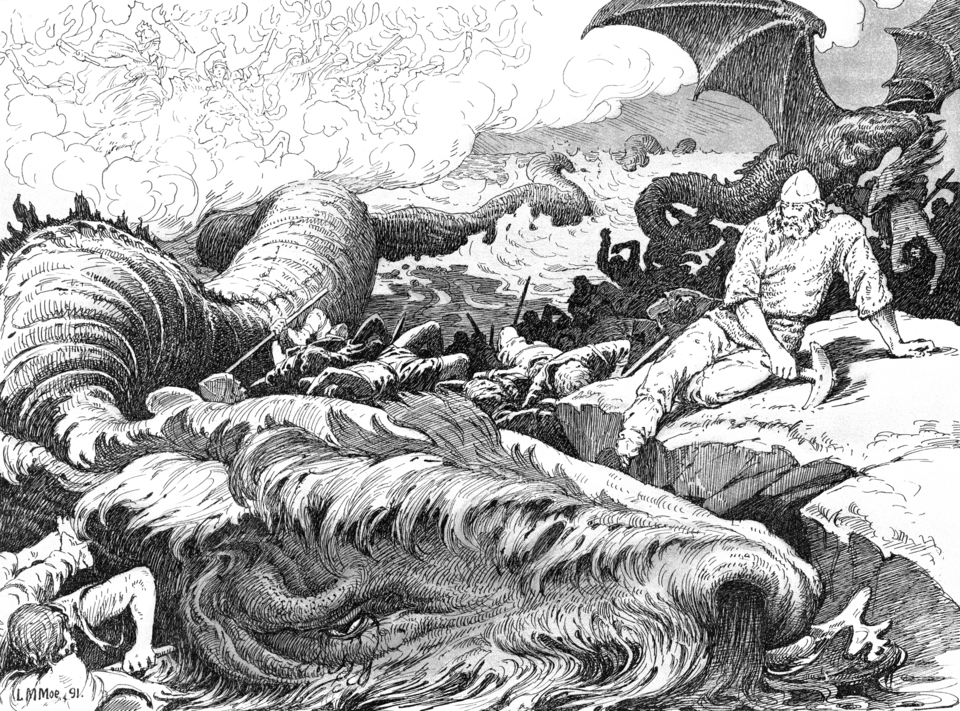
The mark is aimed at them. A ward names its target, which makes these the sharpest attributions on the page.
The larger argument
Why is it in a corpus about spirits?
The tenth-century moulds that cast hammers and crosses in the same workshop are the cleanest archaeological picture the site has of a tradition changing hands. Nobody wrote it down. The evidence that two systems were in contact is a piece of soapstone with both shapes cut into it.
Afterwards
What did it turn into?
Adopted as an emblem by modern Heathen and Ásatrú groups, and separately appropriated by white-nationalist movements — an appropriation those groups have publicly and repeatedly rejected.
Which texts describe it?
Oldest first, with what each one does with the mark. A mark described in a Bronze Age incantation and a mark first drawn in a seventeenth-century manuscript are different kinds of claim, whatever the shape has in common.
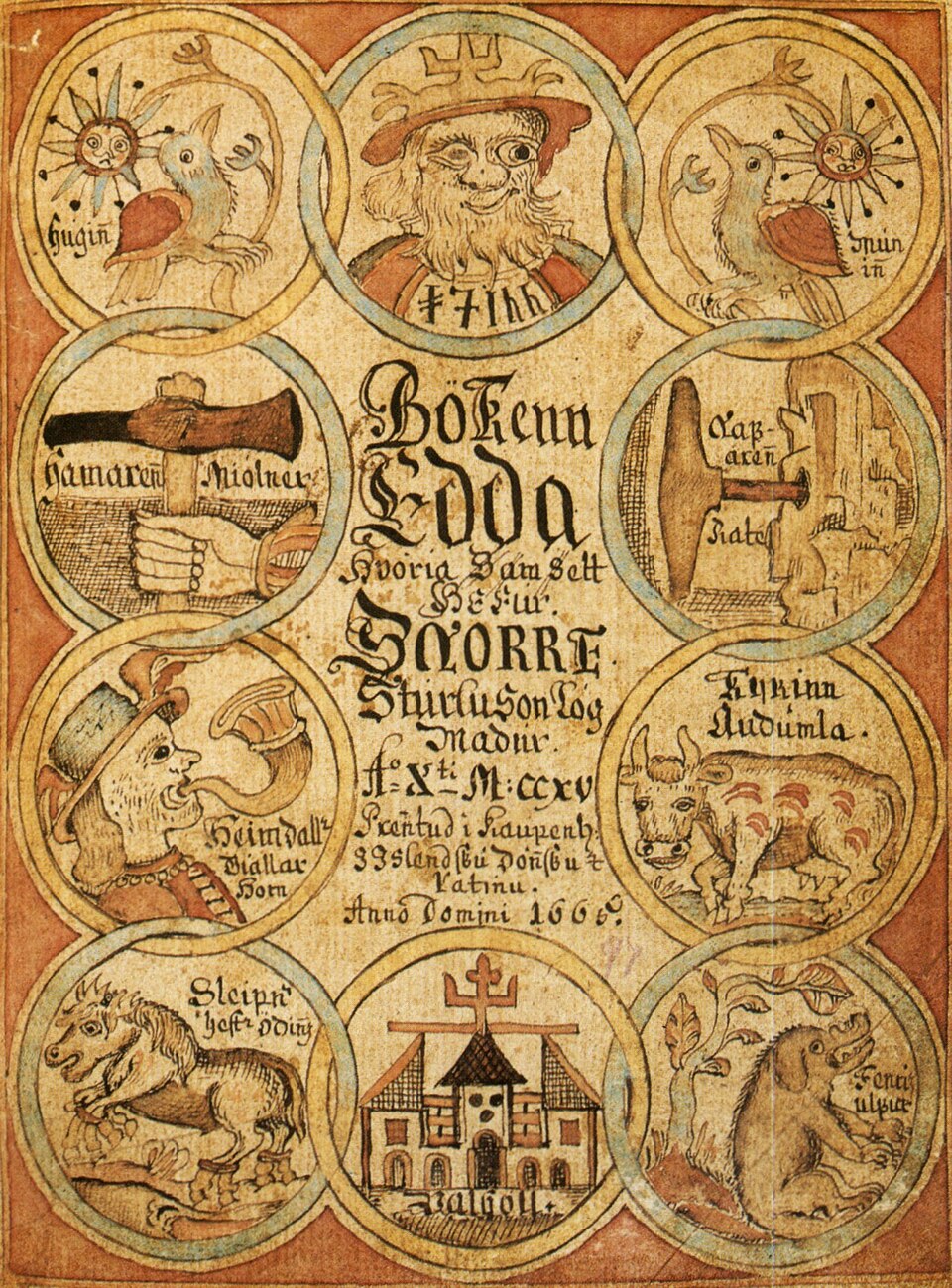
The Prose Edda
Snorri Sturluson; tr. Arthur Gilchrist Brodeur · c. 1220 · Old Norse
Snorri gives the forging, the short handle, and the hallowing of the goats.
Read The Prose Edda in full ↗Cover: Public domain · Unknown author · Wikimedia file page
The Poetic Edda
Anonymous; compiled in Iceland · 13th c., from older oral material · Old Norse
Laid in the bride's lap in Þrymskviða — the hammer as a wedding rite, not a weapon.
Read The Poetic Edda in full ↗Cover: Public domain · The Elder or Poetic Edda; commonly known as Sæmund's Edda. Edited and translated with… · Wikimedia file page
Nearby
Related marks
The Runes
An alphabet that the poems say Odin obtained by hanging himself on a tree for nine nights — writing acquired as an ordeal.
The Triquetra
Three interlaced arcs from Insular manuscript art — read as the Trinity by the people who drew it, and as pre-Christian by nearly everyone since.
The Valknut
Three interlocking triangles on picture stones and ship burials, always near Odin, and never once explained by a surviving text.
The Helm of Awe
Eight tridents radiating from a point, drawn between the eyebrows before a fight — an Icelandic magical stave with an Eddic name attached to it.
The Ankh
The sign for 'life', held to the nose of a king by a god. Not an amulet first — a hieroglyph that got carried into three dimensions.
The Djed Pillar
A four-tiered column meaning stability, later read as the backbone of Osiris and raised upright at festival as a resurrection.