protective · attested from c. 900 CE
The Torii
Two uprights and two crossbars marking where ordinary ground stops — a gate with no door, no wall and nothing to keep out.
What the sources claim for it
A threshold, declared. What changes on crossing it is the status of the ground, not the level of protection.
History
Where does the Torii come from?
A torii stands at the entrance to a Shinto shrine and marks the transition from the everyday to the sacred. It has no gate leaf, is frequently not attached to any fence, and is often one of a long series; visitors bow when passing through and traditionally avoid the exact centre, which is the kami's path.
It is the purest boundary marker in this corpus. A Solomonic circle keeps something out by force of the names on it; a torii keeps nothing out at all and works entirely by declaring where you now are. The mark does not defend the boundary; it is the boundary.
1 figure
Who is it attached to?
Figures who carry it
An attribute rather than a signature — held, worn or associated in the texts and the images.
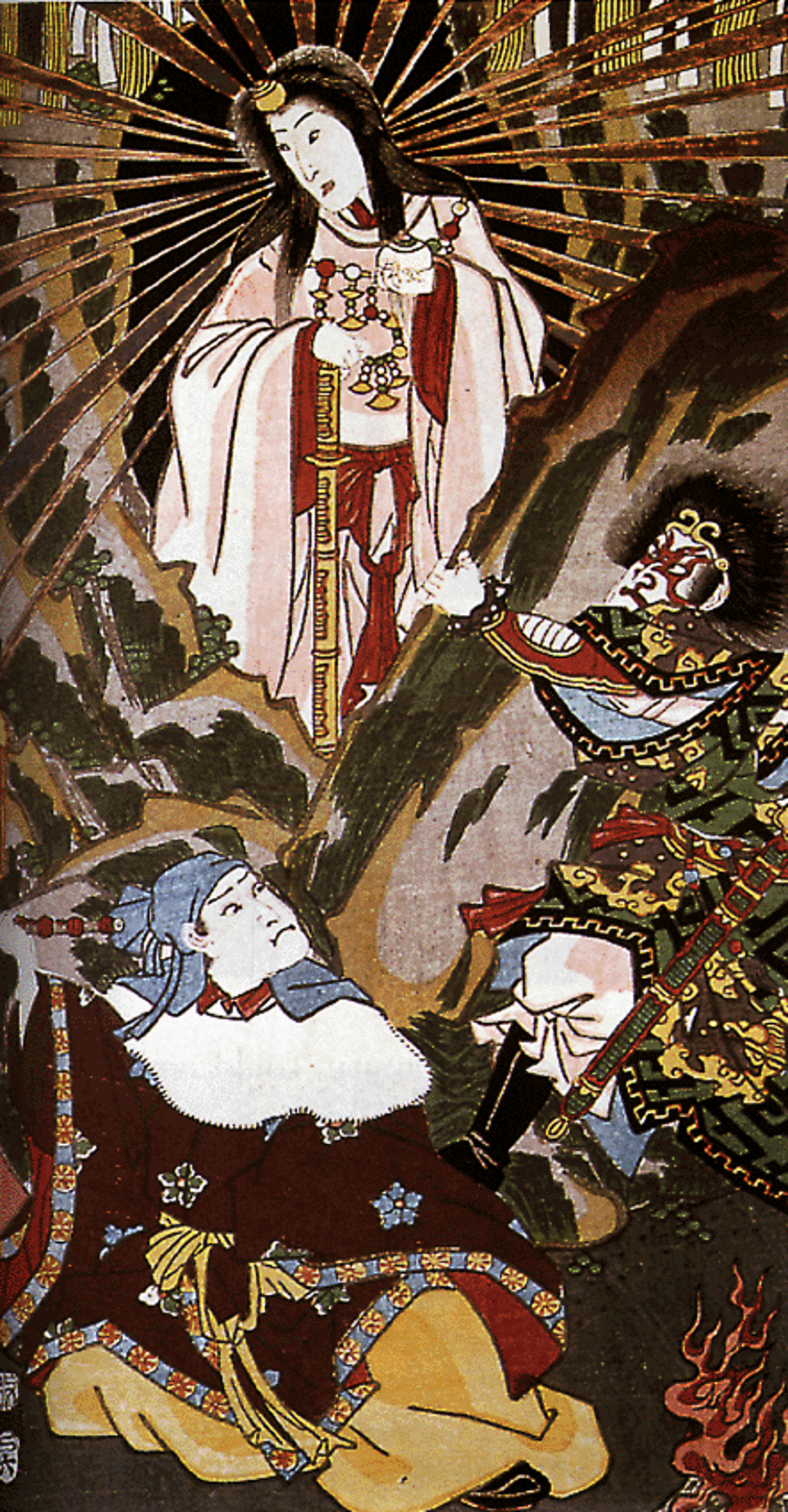
Afterwards
What did it turn into?
The standard shorthand for Japan in international signage and emoji, and the subject of continuing concern about tourists treating shrine gates as photographic backdrops.
Which texts describe it?
Oldest first, with what each one does with the mark. A mark described in a Bronze Age incantation and a mark first drawn in a seventeenth-century manuscript are different kinds of claim, whatever the shape has in common.
Kojiki (Records of Ancient Matters)
Ō no Yasumaro · 712 CE · Old Japanese
The shrine practice the gate belongs to is the one the chronicle's myths are told to support.
Read Kojiki (Records of Ancient Matters) in full ↗Cover: Public domain · Wikimedia file page
Nihongi (Nihon Shoki)
Prince Toneri and others; tr. W. G. Aston · 720 CE · Classical Japanese
The parallel chronicle for the same cult apparatus.
Read Nihongi (Nihon Shoki) in full ↗Cover: Public domain · Unknown author · Wikimedia file page
Nearby
Related marks
The Three Sacred Treasures
A mirror, a curved jewel and a sword — each one a prop from a specific myth, and together the objects that make an emperor.
The Shimenawa
A twisted rice-straw rope with folded paper streamers, tied around a tree, a rock, a wrestler or a doorway to mark it as not ordinary.
The Ankh
The sign for 'life', held to the nose of a king by a god. Not an amulet first — a hieroglyph that got carried into three dimensions.
The Djed Pillar
A four-tiered column meaning stability, later read as the backbone of Osiris and raised upright at festival as a resurrection.
The Star of Ishtar
Eight points for the planet Venus, and the standard way of writing a goddess into a scene without drawing her.
The Uraeus
A cobra rearing at the front of a crown, understood as the eye of the sun placed where it can spit at whatever approaches the wearer's face.