geometric · current form from c. 1070 CE
The Taijitu
Two interlocking halves, each carrying a dot of the other — a Song-dynasty diagram of a much older idea, not an ancient emblem.
What the sources claim for it
Alternation rather than opposition: each half is already becoming the other.
History
Where does the Taijitu come from?
Yin and yang as complementary and alternating principles are old, and run through the Yijing and Han cosmology. The familiar rotationally symmetric diagram is not: it belongs to Song-dynasty Neo-Confucian work on the Supreme Ultimate, and the version everyone recognises is later still.
The two dots do the real work. Without them the diagram would say opposition; with them it says that each principle contains the seed of its own opposite and turns into it. That is the specific claim, and it is the one most often lost when the shape is used decoratively.
Afterwards
What did it turn into?
Adopted worldwide as a general emblem of balance, and, since 1954, as the sign for a South Korean naval and national flag device with a different colour scheme and its own history.
Which texts describe it?
Oldest first, with what each one does with the mark. A mark described in a Bronze Age incantation and a mark first drawn in a seventeenth-century manuscript are different kinds of claim, whatever the shape has in common.
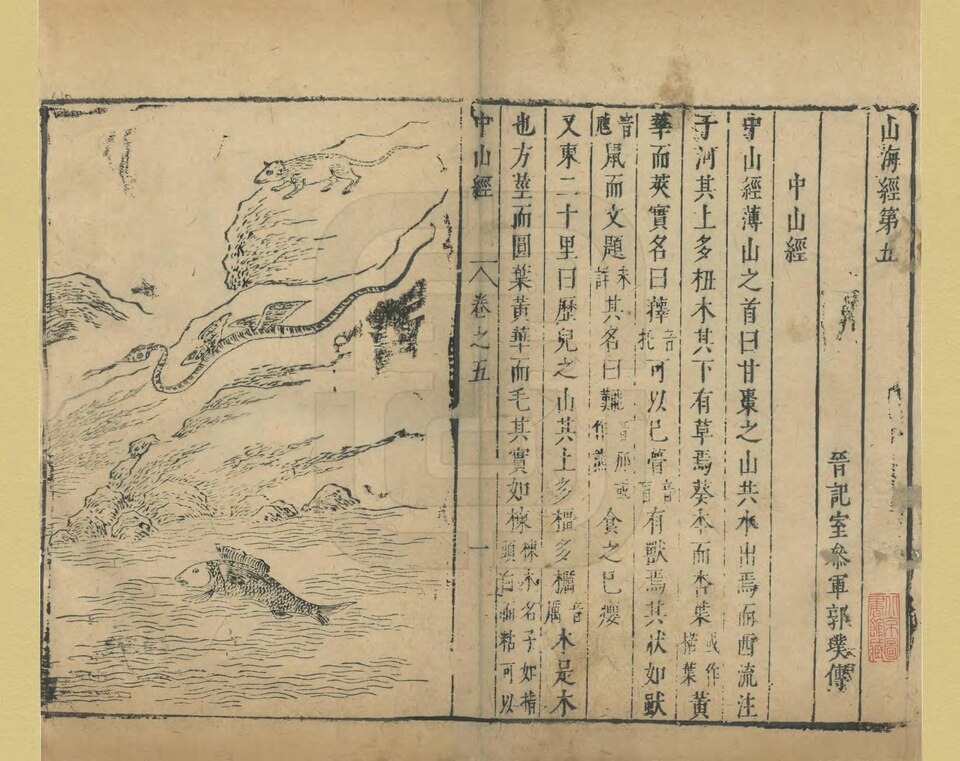
Shanhaijing (Classic of Mountains and Seas)
Anonymous · 4th c. BCE - 2nd c. CE · Classical Chinese
Belongs to the same classical Chinese cosmological world the Classic of Mountains and Seas maps.
Read Shanhaijing (Classic of Mountains and Seas) in full ↗Cover: Public domain · National Library of China · Wikimedia file page
Nearby
Related marks
The Eight Trigrams
Eight stacks of three broken or unbroken lines — a complete three-bit notation, arranged in a ring and hung over doorways.
The Fu Talisman
A strip of yellow paper carrying characters that are not quite characters — a written order to the spirit bureaucracy, issued under seal.
The Triple Spiral
Three joined spirals cut into a kerbstone at Newgrange five thousand years ago — older than the pyramids, and completely unexplained.
The Pentagram
A five-pointed star drawn in one unbroken line — an accounting mark, a Pythagorean password, a Christian emblem of the five wounds, and only recently a sign of evil.
The Ouroboros
A serpent swallowing its own tail, first drawn around the sun god in an Egyptian tomb and still in use three thousand years later as a diagram of a closed system.
The Dharmachakra
An eight-spoked wheel for an eightfold path — the emblem Buddhism used for its founder for four centuries before it would depict him at all.