Tradition
Chinese
The celestial bureaucracy — a heaven organised as an imperial civil service, with the underworld as its judiciary.
What is the Chinese tradition?
The distinctive feature of Chinese religious cosmology is administrative. Heaven is organised as an imperial civil service, with ranks, jurisdictions, appointments, promotions and paperwork, and the underworld is its judiciary — courts that assess a life against a record.
That is a genuinely different organising metaphor from the ones elsewhere in this corpus, where hierarchy is usually military or courtly rather than bureaucratic, and it produces different questions. What ranks a spirit is its office and its jurisdiction rather than its power.
It is also syncretic by construction. The pantheon absorbs Daoist, Buddhist and local material continuously, and figures move between the three with their identities intact — which makes it one of the better places on this site to watch syncretism happening as ordinary practice rather than as conquest.
Which texts does this tradition rest on?
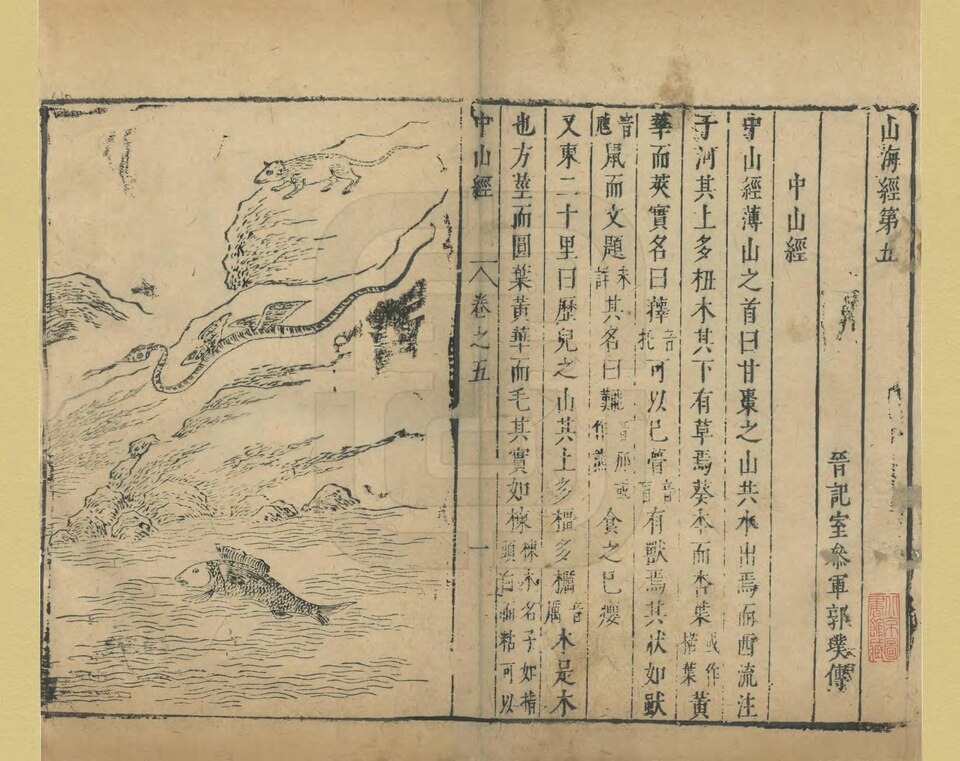
Shanhaijing (Classic of Mountains and Seas)
Anonymous · 4th c. BCE - 2nd c. CE
A geographic and bestiary compilation cataloguing hundreds of gods and monsters by the mountain they inhabit — closer in form to the Goetia than anything else in the ancient world.
3 entries contributed
The Huainanzi
Compiled under Liu An, King of Huainan · c. 139 BCE
A Han compendium of philosophy and cosmology presented to the emperor, and the source of the version of the broken sky everyone knows: Nüwa smelting five-coloured stones to patch heaven and cutting the legs off a turtle to prop up its corners after Gonggong knocked the pillar down. The Shanhaijing lists such figures; this explains what they did and why the world is lopsided as a result.
3 entries contributed
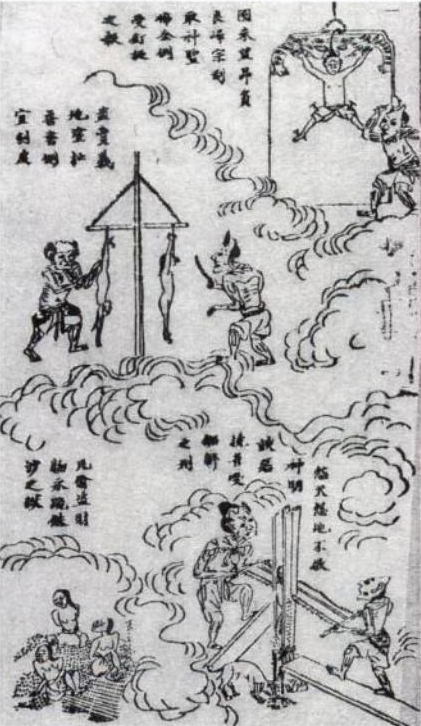
The Scripture of the Ten Kings
Anonymous Chinese Buddhist · 9th-10th c. CE
The text that organises the Chinese underworld into ten courts with a presiding magistrate for each. Yanluo belongs to this Buddhist-derived material, not to the far older Shanhaijing.
2 entries contributed
Journey to the West
Attributed to Wu Cheng'en · c. 1592
A Ming novel, carried here as reception rather than as doctrine, and the reason the Chinese underworld bureaucracy is familiar to people who have never read a sutra. Its most useful episode for this corpus is the Monkey King dragged before the king of the dead, seizing the register of lives and striking his own name out of it — a comedy about jurisdiction that assumes a reader already knows exactly how that court is supposed to work.
1 entries contributed
Which marks belong to it?
Oldest first. A mark used by several traditions appears on each of their pages — which is the point: the shapes crossed these boundaries far more easily than the names did.
The Eight Trigrams
from c. 800 BCE
Eight stacks of three broken or unbroken lines — a complete three-bit notation, arranged in a ring and hung over doorways.
The Fu Talisman
from c. 200 CE
A strip of yellow paper carrying characters that are not quite characters — a written order to the spirit bureaucracy, issued under seal.
The Taijitu
current form from c. 1070 CE
Two interlocking halves, each carrying a dot of the other — a Song-dynasty diagram of a much older idea, not an ancient emblem.
Who is filed under Chinese?
Ordered by attestation score — how early and how independent the texts that name each figure are, rather than how famous the figure has since become.
Gonggong
The Water Lord · Chinese
The Chinese water god who loses a fight and knocks down the pillar holding up the sky — which is why the heavens tilt one way, the rivers run the other, and Nüwa has repairs to make.

Nüwa
Creator Goddess · Chinese
She makes people from yellow earth and patches the broken sky with five-coloured stones. A creator whose defining act is repair.
Xiwangmu
Queen Mother of the West · Chinese
The Chinese goddess who begins as a tiger-toothed sender of plagues in the Classic of Mountains and Seas and ends as the serene keeper of the peaches of immortality — a demotion running backwards.
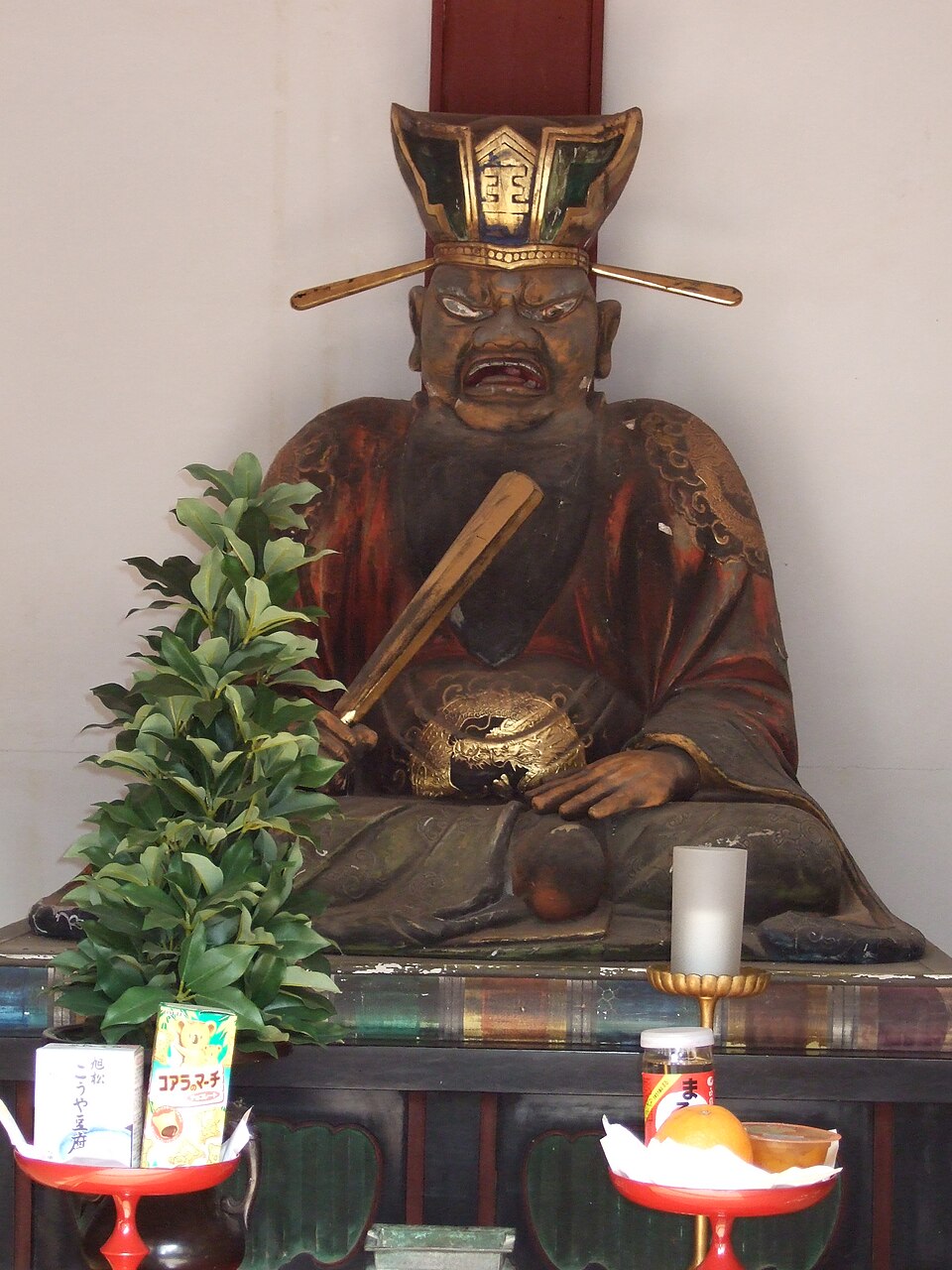
Yanluo Wang
Judge of the Dead · Chinese
Chief judge of the Chinese underworld — a civil servant with a ledger, in a hell organised as a court system rather than a torture chamber.
The Ten Kings
Court of the Dead · Chinese
The Chinese court of the dead — ten magistrates who each hear a case at a fixed interval after death, with clerks, registers and a right of appeal, and Yanluo Wang sitting fifth.