seal · from c. 1300 CE
The Smoking Mirror
A polished obsidian disc that shows smoke as well as a face — a god's name, his missing foot, and a working divination instrument at once.
What the sources claim for it
Sight into what is hidden, and the ruler's exposure to being seen in turn.
History
Where does the Smoking Mirror come from?
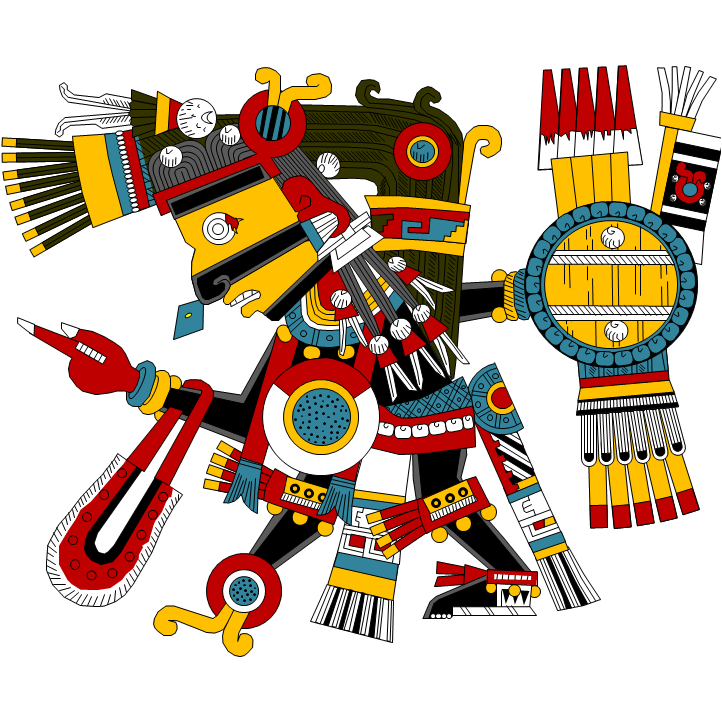
Tezcatlipoca's name means smoking mirror, and the codices show him with an obsidian disc trailing smoke in place of one foot, or set at the back of his head. Polished obsidian mirrors were real objects used for divination, and the god is the patron of rulers, sorcery and the things seen in them.
It is a rare case of a deity named after a piece of equipment rather than the reverse. The mirror also travelled: John Dee's obsidian scrying mirror, now in the British Museum, has been shown by geochemical analysis to be Aztec, which puts an Aztec divination instrument at the centre of the Enochian sessions elsewhere in this corpus.
1 figure
Who is it attached to?
Figures who carry it
An attribute rather than a signature — held, worn or associated in the texts and the images.
Afterwards
What did it turn into?
Dee's mirror was catalogued for centuries as an obscure curio before its Mexican origin was confirmed in 2021 — the clearest documented physical link between Mesoamerican and European ritual practice.
Which texts describe it?
Oldest first, with what each one does with the mark. A mark described in a Bronze Age incantation and a mark first drawn in a seventeenth-century manuscript are different kinds of claim, whatever the shape has in common.
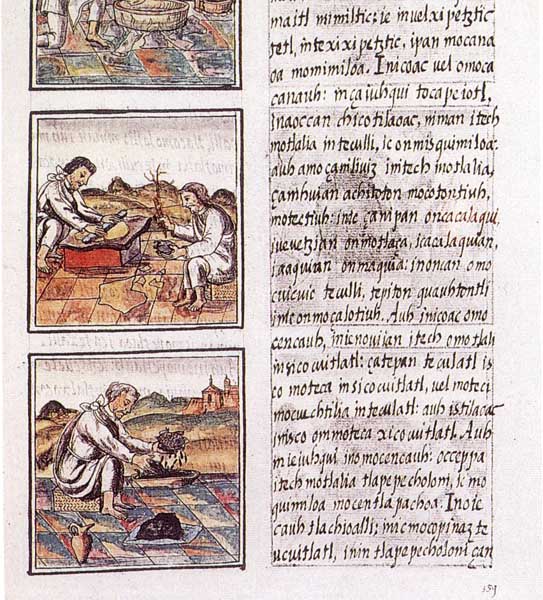
Florentine Codex
Bernardino de Sahagún with Nahua informants · 1545-1590 · Nahuatl and Spanish
Tezcatlipoca's attributes and cult, from Sahagún's Nahua informants.
Read Florentine Codex in full ↗Cover: Public domain · Bernardino de Sahagún · Wikimedia file page
Nearby
Related marks
The Feathered Serpent
A snake with quetzal plumage, carved at Teotihuacan a thousand years before the Aztecs — a symbol that outlasted several of the states that used it.
The Celestial Alphabets
Three alphabets Agrippa prints for writing the names of angels — Hebrew letters redrawn with rings at the joints, so that a script becomes a set of sigils.
Sigillum Dei Aemeth
A nine-inch wax disc of nested heptagons carrying angel names, made to stand under the legs of a table — the physical foundation of the Enochian sessions.
The Enochian Alphabet
Twenty-one letters dictated square by square from lettered grids, in a script the sessions claimed was the language Adam spoke.
The Was Sceptre
A straight staff with a forked foot and an animal head — and the animal, on the best reading, is Set's.
The Rod and Ring
The objects a seated god hands to a standing king at the top of Hammurabi's stele — most likely a measuring rod and a coiled line.