protective · from c. 500 CE
The Lilith Amulet
Hung over a birthing bed, naming three angels — a ward that works by holding a demon to something she agreed to.
What the sources claim for it
A demon bound by her own undertaking. The names are the record of the agreement, not a weapon.
What is it made of?
The Aramaic incantation bowls and their medieval descendants use a fixed formula, and its parts are the parts of a legal document.
The three angels
Senoy, Sansenoy, Semangelof
The name written
The spiral text
The bound figure
Lilith Amulet
- 01
The three angels · Senoy, Sansenoy, Semangelof — Named on almost every example. Their power is jurisdictional: Lilith swore an oath to them, and the amulet holds her to it.
- 02
The name written — Lilith named explicitly. A ward that names its target is the sharpest kind of attribution in this corpus.
- 03
The spiral text — On the bowls the writing runs inward in a spiral, and the bowl is buried inverted under the threshold — the text is a trap with a shape.
- 04
The bound figure — Some bowls draw the demon at the centre, hands and feet chained, inside her own name.
History
Where does the Lilith Amulet come from?
Babylonian incantation bowls of the fifth to seventh centuries name Lilith and her kind, and the practice continues in parchment and metal amulets into the modern period. The standard European form names three angels — Sanoi, Sansanoi and Semangelof — and often carries the phrase 'Adam and Eve, out Lilith'.
The narrative attached to it in the medieval Alphabet of Ben Sira makes the mechanism explicit: Lilith agrees that wherever she sees the names of those three angels, she will not take the child. The amulet is not repelling her by force. It is holding her to terms — the same logic the Solomonic material runs on a thousand years later.
1 figure
Who is it attached to?
Figures it is used against
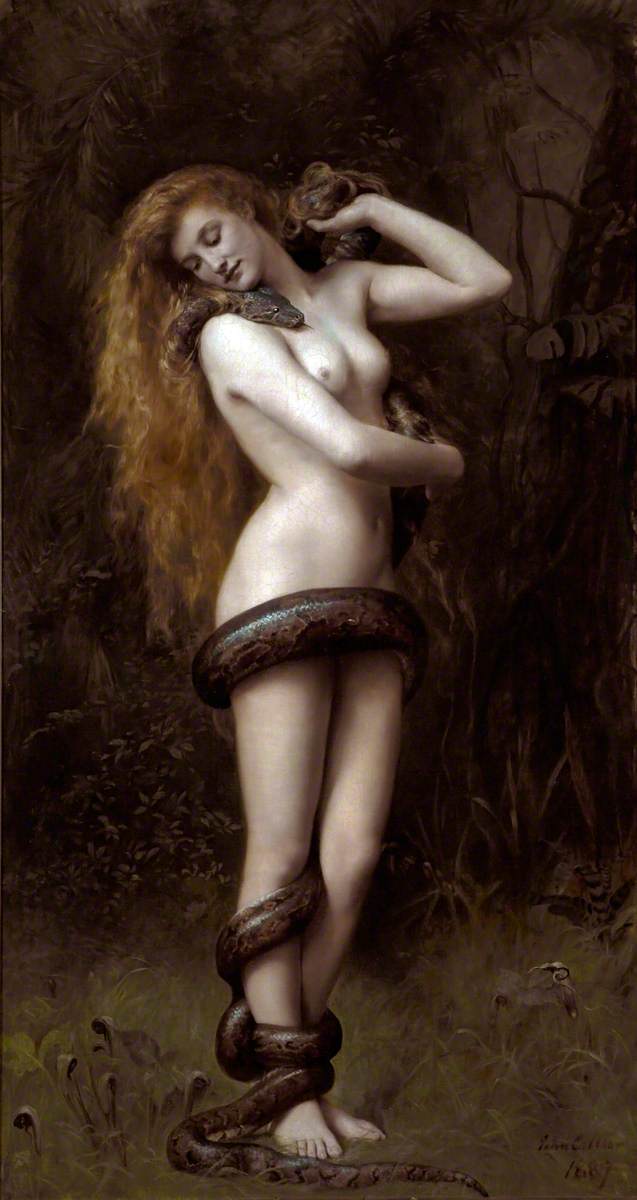
The mark is aimed at them. A ward names its target, which makes these the sharpest attributions on the page.
The larger argument
Why is it in a corpus about spirits?
Here the whole apparatus of compulsion appears in domestic use, centuries before any grimoire. An ordinary household buries a legal instrument under the floor which names a demon, cites the oath she is bound by, and lists the authorities enforcing it. The Solomonic material did not invent that procedure; it professionalised it.
Afterwards
What did it turn into?
Lilith's twentieth-century reinterpretation as a figure of refused subordination has largely displaced the amulet context, which was overwhelmingly about infant mortality.
Which texts describe it?
None, and here is why
Two texts would carry this page and neither is in the corpus yet. The narrative that makes the amulet work — Lilith undertaking that wherever she sees the three angels' names she will not take the child — is in the medieval Alphabet of Ben Sira, and the earliest physical witnesses are the Jewish Aramaic incantation bowls of Babylonia. This corpus holds Akkadian incantations against Lamashtu, who is very likely Lilith's ancestor, but that is a different body of text and citing it here would claim a continuity the tablets do not state.
Nearby
Related marks
The Standing Stone
An upright unworked stone marking a place where something happened — the oldest kind of monument, and one the Bible both erects and forbids.
The Incantation Bowl
A plain clay bowl with writing spiralling inward across the inside, buried upside down under the floor of a house. Around two thousand survive, and they name demons by name.
The Hamsa
An open hand against the evil eye, claimed in nearly identical form by Jewish, Muslim and Christian communities across the same geography.
AGLA
An acronym, not a word: Atah Gibor Le-olam Adonai, 'Thou art mighty forever, Lord', compressed to four letters and written on almost everything.
The Hexagram
Two interlocked triangles that were ornament almost everywhere before they were a Jewish emblem anywhere — and a spirit-binding seal in between.
The Pentagram
A five-pointed star drawn in one unbroken line — an accounting mark, a Pythagorean password, a Christian emblem of the five wounds, and only recently a sign of evil.