protective · as an Islamic emblem from c. 1450
The Crescent and Star
Nothing to do with the Qur'an and everything to do with Constantinople — a Byzantine city emblem inherited by the empire that took the city.
What the sources claim for it
In origin a city's device, then a dynasty's, then a state's. The religious reading is imposed from outside and accepted afterwards.
History
Where does the Crescent and Star come from?
The crescent is an ancient Near Eastern lunar sign, and it was in use in Byzantium long before 1453; the star-and-crescent pairing appears on the city's coinage and standards. The Ottomans took the city and, over the following centuries, the emblem, which by the eighteenth and nineteenth centuries was flying as an imperial and then a state device.
Because the Ottoman state was the most visible Muslim power to European eyes, the emblem was read outside the Islamic world as meaning Islam itself, and the successor states of the empire carried it onto their flags. There is no scriptural basis for it whatsoever, and Islamic authorities regularly point that out — the Islamic lunar calendar explains the affection for the crescent, not any command about it.
Afterwards
What did it turn into?
On the flags of Turkey, Pakistan, Tunisia, Algeria, Malaysia and others, used by the Red Crescent since 1876, and treated worldwide as the counterpart to the cross — a symmetry the tradition itself never proposed.
Which texts describe it?
Oldest first, with what each one does with the mark. A mark described in a Bronze Age incantation and a mark first drawn in a seventeenth-century manuscript are different kinds of claim, whatever the shape has in common.
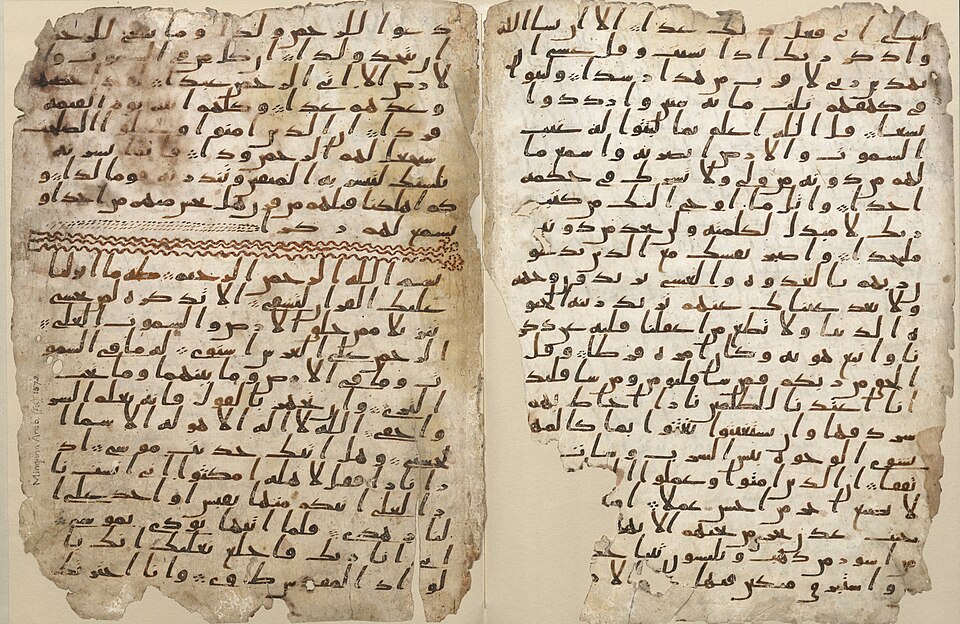
Qur'an & Hadith
Various · 7th c. CE onward · Arabic
The lunar calendar the crescent's affection rests on; the emblem itself is absent from scripture.
Read Qur'an & Hadith in full ↗Cover: Public domain · AnonymousUnknown author · Wikimedia file page
Nearby
Related marks
The Nazar
Blue glass with a white and black eye at its centre, worn on the theory that a look can be sent back.
The Seal of Solomon
A signet ring, not a shape. The Testament of Solomon makes it the instrument by which every demon in the book is compelled to give its name.
The Brass Vessel
The container the legend says Solomon sealed the spirits into, thrown into a lake and opened by Babylonians who expected treasure. It is where the Ars Goetia says its seventy-two came from.
Āyat al-Kursī
One verse, recited at night and inscribed on doorways and pendants, and named in hadith as what keeps a guard over you until morning.
The Hamsa
An open hand against the evil eye, claimed in nearly identical form by Jewish, Muslim and Christian communities across the same geography.
The Hexagram
Two interlocked triangles that were ornament almost everywhere before they were a Jewish emblem anywhere — and a spirit-binding seal in between.