protective · in continuous use; documented from the 19th century
The Iron of Ògún
Not an image but a material: worked iron itself — machete, anvil, nails, and now car parts — is Ògún's presence.
What the sources claim for it
The metal itself, and everything cut, forged, driven or fought with it.
History
Where does the Iron of Ògún come from?
Ògún is the god of iron, of the forge, of hunting and of war, and his shrines are assemblages of iron objects rather than depictions of a figure. Oaths are sworn on a piece of iron, and the substance is the guarantor: to swear on Ògún is to touch the metal.
The category has stayed open, which is unusual. Because the god's domain is worked iron rather than any particular tool, drivers, mechanics, soldiers and surgeons all fall under him, and shrine assemblages now include vehicle parts. Very few symbol traditions in this corpus have absorbed industrial modernity without a break.
1 figure
Who is it attached to?
Figures who carry it
An attribute rather than a signature — held, worn or associated in the texts and the images.
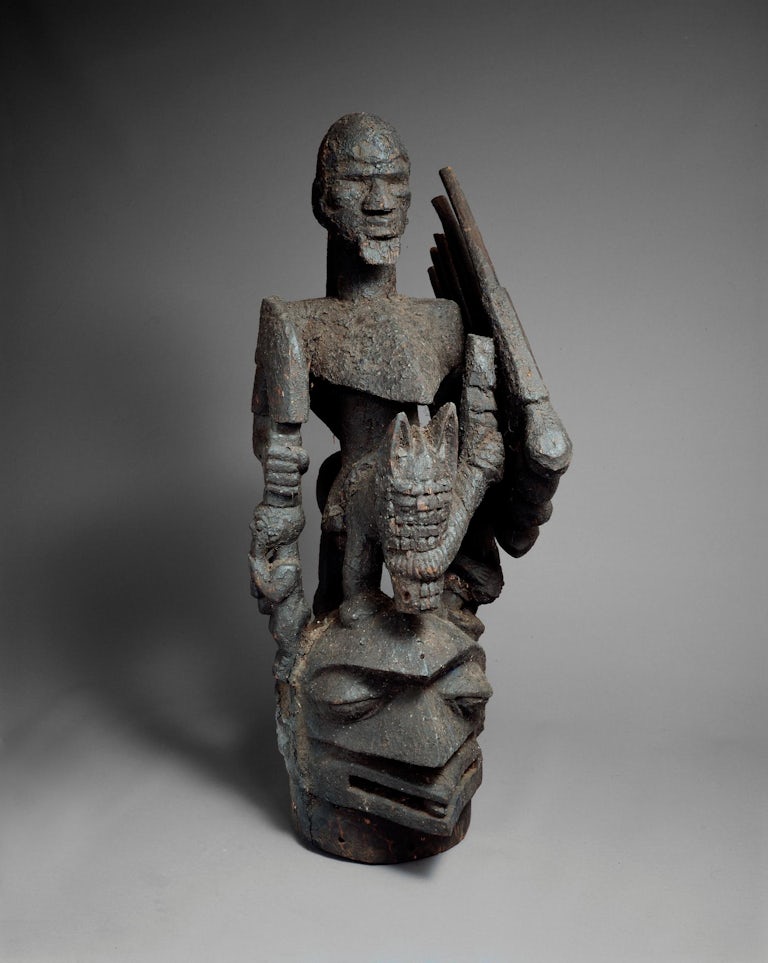
Afterwards
What did it turn into?
Carried to the Americas and continuous in Candomblé and Santería; the association with drivers and mechanics is now standard across West Africa.
Which texts describe it?
Oldest first, with what each one does with the mark. A mark described in a Bronze Age incantation and a mark first drawn in a seventeenth-century manuscript are different kinds of claim, whatever the shape has in common.
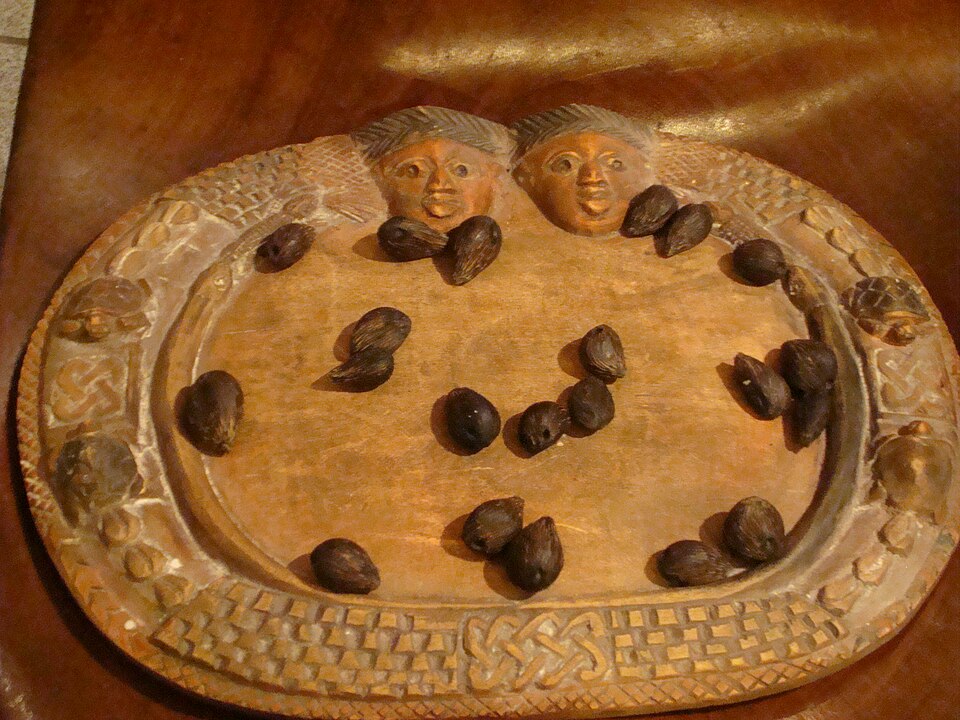
The Odu Ifá
Oral; transmitted by babalawo · Oral tradition, first transcribed 19th-20th c. · Yoruba
Ògún's character, offices and taboos in the divination verses.
Read The Odu Ifá in full ↗Cover: Public domain · Toluaye · Wikimedia file page
Nearby
Related marks
The Opón Ifá
A carved wooden tray dusted with powder, marked in sixteen possible figures — and with Èṣù's face cut into the rim, watching the border.
The Oṣé Ṣàngó
A double-headed axe carried on the head of a dancer — and, in practice, the neolithic stone celts that turn up in fields after a storm.
The Ankh
The sign for 'life', held to the nose of a king by a god. Not an amulet first — a hieroglyph that got carried into three dimensions.
The Djed Pillar
A four-tiered column meaning stability, later read as the backbone of Osiris and raised upright at festival as a resurrection.
The Star of Ishtar
Eight points for the planet Venus, and the standard way of writing a goddess into a scene without drawing her.
The Uraeus
A cobra rearing at the front of a crown, understood as the eye of the sun placed where it can spit at whatever approaches the wearer's face.